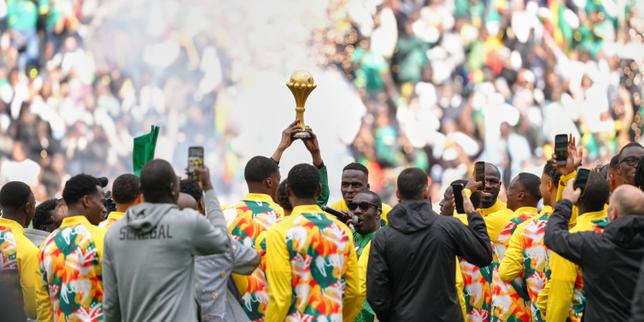
The presentation of the African Cup of Nations (CAN) trophy at the Stade de France to the Senegalese diaspora represents more than a celebratory event; it is a calculated deployment of a "sovereign emotional asset." When the Senegalese federation brings this trophy to Paris, they are executing a strategic engagement with their most significant external economic engine: the diaspora. This maneuver transitions the trophy from a mere sporting prize into a tool for national branding and human capital retention.
The Mechanics of Diaspora Connectivity
The decision to hold this event in Saint-Denis, France, rather than exclusively within the borders of Senegal, acknowledges a fundamental demographic reality. The Senegalese diaspora serves as a primary source of foreign direct investment through remittances, but their value extends beyond liquidity. They are the frontline of Senegal’s global influence.
By framing the event around the concept of being the "only champions of Africa," the organizers utilize an exclusivity principle. This creates a high-value internal brand for Senegalese nationals, distinguishing their "product" (the national team) from continental peers. The logic follows a three-pillar framework:
- Validation of the Migrant Investment: For the diaspora, supporting the national team is a financial and emotional commitment. Bringing the trophy to their doorstep provides a tangible "dividend" on that investment.
- Cultural Territoriality: Utilizing the Stade de France—a venue synonymous with French national pride—to celebrate a Senegalese victory asserts a form of soft power. It signals that Senegalese excellence is not localized to Dakar but is a portable, global standard.
- Recruitment Pipeline Security: The national team’s future depends on dual-national talent developed in European academies. High-visibility events in Paris serve as a marketing funnel for the next generation of players, ensuring they view the Teranga Lions as a premier professional destination rather than a secondary option.
The Logistics of Symbolism
Transporting a major international trophy across borders involves significant security protocols and diplomatic coordination. These overhead costs are justified by the projected "Brand Equity" increase. While a standard friendly match generates ticket revenue, a trophy presentation generates loyalty equity. This is harder to quantify but directly correlates with long-term sponsorship valuations.
Sponsors of the Senegalese federation are not just buying space on a jersey; they are buying access to the concentrated attention of millions of viewers across two continents. The Paris event maximizes "Impressions per Kilometre." By moving the trophy to the fans, the federation increases the asset's utility rate. A trophy sitting in a cabinet in Dakar has a static value; a trophy moving through the streets of Paris has a kinetic, compounding value.
Strategic Friction and Competition
The claim of being the "only champions" is a deliberate rhetorical device used to create a monopoly on regional prestige. In the competitive landscape of African football, status is a zero-sum game. If Senegal is the definitive champion, the brand value of their rivals—Cameroon, Algeria, or Ivory Coast—is marginalized within the immediate discourse.
This creates a "Winner-Takes-All" market dynamic for continental endorsements. Global brands seeking a "Pan-African" face will gravitates toward the team that most effectively projects its dominance beyond its own borders. The Stade de France event is a live-action pitch to these global partners, demonstrating that the Senegalese brand is "European-compatible" in its professional execution.
The Risk of Over-Extension
There is a latent risk in decoupling the celebration from the home soil. If the domestic population perceives that the "crown jewels" are being prioritized for a foreign-based audience, it can erode the grassroots support that forms the base of the team's identity.
The federation must balance this by maintaining a strict hierarchy of access:
- Tier 1: National celebrations (Dakar) – Direct state validation.
- Tier 2: International diaspora tours (Paris) – Economic and soft power expansion.
- Tier 3: Digital engagement – Global reach.
Failure to maintain the primacy of Tier 1 can lead to a "hollowed-out" brand where the team feels like a nomadic franchise rather than a national representative. However, the data from the Stade de France suggests the synergy between the home base and the diaspora remains strong, provided the narrative remains one of "shared conquest."
Operationalizing National Pride
The "Teranga" brand—traditionally defined by hospitality—is being re-engineered into a brand defined by "Dominance." This shift is critical for Senegal’s broader geopolitical ambitions. Successful sports management is often a precursor to successful trade and diplomatic negotiations. When a state can demonstrate the discipline and excellence required to win a continental championship and the organizational sophistication to tour it internationally, it signals "State Capacity."
Investors look for signals of stability and high-level execution. A well-managed national team serves as a proxy for a well-managed sector. The precision of the event at the Stade de France—coordinating with French authorities, managing thousands of attendees, and ensuring the security of the asset—is a demonstration of Senegalese operational excellence.
The Displacement of the Colonial Narrative
By occupying the Stade de France for a victory celebration unrelated to French success, Senegal performs a symbolic inversion. The stadium, built for the 1998 World Cup, is a monument to French "Black-Blanc-Beur" integration. Senegal’s presence there, celebrating an independent African achievement, recalibrates the relationship between the former colony and the metropole. It is no longer about integration into a French system; it is about the assertion of a Senegalese system on a global stage.
The "Only Champions" slogan serves as a boundary marker. It shuts out the noise of past failures and focuses the lens on a current, measurable period of hegemony. For the analyst, this is an exercise in "Narrative Control." The federation is not just showing a trophy; they are dictating the terms of how African footballing success is perceived in the heart of Europe.
Strategic Recommendations for Asset Monetization
To maximize the ROI of this trophy cycle, the Senegalese federation should shift from event-based management to a platform-based model. This involves:
- Digital Twin Assets: Creating a verifiable digital presence for the trophy tour (via high-fidelity content or blockchain-backed mementos) to capture data from the diaspora participants.
- Bilateral Trade Integration: Using future "trophy tours" as anchors for trade missions. Where the trophy goes, Senegalese businesses (in tech, agriculture, and textiles) should follow, leveraging the crowd's attention to facilitate B2B networking.
- Institutionalized Talent Scouting: Formalizing the link between the "celebration" and "observation." Every diaspora event should be paired with technical clinics that allow the federation to map the talent density of the region.
The current strategy has successfully captured the "Sentiment Market." The next evolution must capture the "Structural Market" by turning these moments of high emotional density into permanent pathways for capital and talent flow back to Dakar. The Stade de France event was a successful proof of concept; the scaling of this model will determine if Senegal can maintain its position as the preeminent sporting and soft-power hub in West Africa.
The immediate priority for the federation is to secure the rights for a recurring "Champions Series" that utilizes the diaspora's purchasing power during the off-season. This would move the revenue model away from erratic tournament bonuses toward a predictable, subscription-like engagement with the global Senegalese community. By treating the national team as a decentralized global entity rather than a localized project, Senegal can insulate its sports economy from domestic market fluctuations and establish a permanent footprint in the global sports industry.