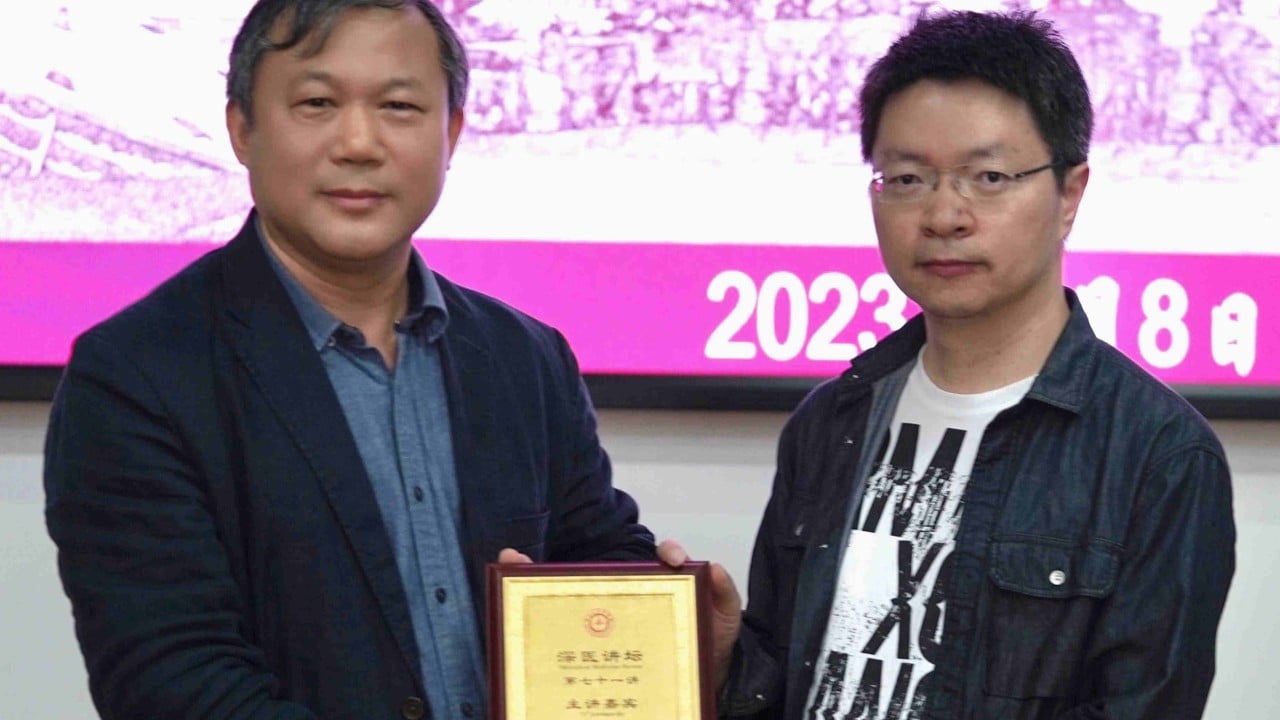
The departure of Shu Xiaokun, a decorated cellular pharmacologist from the University of California, San Francisco, to the University of Hong Kong is not an isolated career move. It is a symptom of a systemic hemorrhage. For over a decade, Shu functioned as a cornerstone of American biomedical innovation, securing millions in National Institutes of Health (NIH) funding to pioneer fluorescent protein technologies that visualize cellular processes in real-time. His sudden relocation to China signals a tectonic shift in where the world’s most ambitious scientists believe they can actually get work done.
When a researcher of this caliber leaves, they don't just take their personal expertise. They take their intellectual property, their specialized lab staff, and the future patents that would have otherwise bolstered the American economy. The narrative often pushed by administrative bodies suggests these moves are merely personal choices or the result of aggressive foreign recruitment. That is a convenient half-truth. The reality is far more clinical. The United States is becoming an environment where the administrative burden, funding instability, and political scrutiny of "China-connected" researchers have created a perfect storm of professional exhaustion.
The Infrastructure of Departure
Shu Xiaokun’s work at UCSF focused on the development of genetically encoded tools. These are the microscopic "flashlights" that allow scientists to see how proteins interact inside a living cell. This isn't just academic curiosity. It is the fundamental groundwork for treating cancer, Alzheimer’s, and rare genetic disorders. Between 2010 and 2023, Shu was the principal investigator on multiple NIH-funded projects, pulling in significant federal investment.
The move to the University of Hong Kong (HKU) as a chair professor of biomedical sciences represents a massive "return on investment" for China, funded largely by the American taxpayer’s initial seed money. China isn't just stealing secrets; they are importing the finished product of the American PhD system.
The "why" behind this migration is rarely about a single paycheck. Scientists at this level are driven by the velocity of discovery. In the current American system, a principal investigator spends roughly 40% of their time writing grants and navigating compliance paperwork. In contrast, the Greater Bay Area in China—encompassing Hong Kong, Shenzhen, and Guangzhou—is currently offering what many call "frictionless" research environments. This includes massive startup packages, pre-built laboratory infrastructure, and a streamlined procurement process for reagents and equipment that can take months to clear customs in the U.S.
The Shadow of the China Initiative
We cannot discuss the departure of Shu Xiaokun without acknowledging the chilling effect of federal oversight. Although the Department of Justice officially ended the "China Initiative" in 2022 following a series of botched prosecutions, the institutional paranoia remains. Universities, terrified of losing federal funding, have implemented internal vetting processes that treat any collaboration with Chinese institutions as a potential security breach.
For a scientist like Shu, whose background and professional network are international, this creates a constant state of defensive accounting. Every trip, every guest lecture, and every co-authored paper becomes a potential liability. When the choice is between staying in a system that views your heritage with suspicion or moving to a system that views you as a national hero, the decision becomes a matter of professional survival.
The NIH itself has been under pressure to investigate "foreign influence," leading to the dismissal or resignation of over a hundred scientists in recent years. While protecting intellectual property is a legitimate national security concern, the heavy-handed nature of these investigations has backfired. Instead of securing American innovation, it has accelerated the transfer of talent to the very rivals the U.S. is trying to outpace.
The Funding Gap and the Valuation of Basic Science
The U.S. funding model is increasingly risk-averse. The NIH tends to fund "sure bets"—research that is already halfway to a result. This creates a stagnant environment for high-risk, high-reward basic science. Shu’s work on protein-protein interactions is the definition of fundamental research. It is the "software" upon which the "hardware" of new drugs is built.
China has recognized this gap. Their funding cycles are currently more comfortable with long-term, speculative research that may not yield a commercial product for a decade. This patience is a luxury the American quarterly-result mindset no longer affords.
Comparison of Research Environments
| Feature | United States (Current) | China/Hong Kong (Current) |
|---|---|---|
| Grant Approval Time | 9 to 18 months | 3 to 6 months |
| Administrative Load | High (Compliance-heavy) | Moderate (Support-heavy) |
| Recruitment Focus | Diversity and Equity | Merit and Output |
| Infrastructure | Aging / Costly Maintenance | State-of-the-art / Subsidized |
| Political Climate | High Scrutiny of Collaborations | Aggressive Talent Acquisition |
This table illustrates the logistical reality. It is not just about the money; it is about the time-to-bench ratio. A scientist in Hong Kong can often move from an idea to an experiment in a fraction of the time it takes a peer in San Francisco or Boston.
The Ripple Effect on the Biotech Economy
When a top-tier lab moves, the local ecosystem suffers a localized cardiac arrest. UCSF is a hub for the San Francisco biotech cluster. Startups are often spun out of the very labs that Shu managed. These companies create jobs, pay taxes, and develop therapies that eventually reach the American public.
By losing Shu, the U.S. loses the "seed corn" of the next generation of biotech firms. The intellectual property developed under NIH grants is often licensed to American companies. If that research is now being completed in Hong Kong, those licenses will be held by Asian firms. We are witnessing the voluntary dismantling of the American monopoly on life sciences.
A Failed Strategy of Containment
The strategy of the last eight years has been one of containment—trying to keep Chinese influence out of American labs. This was a fundamental misunderstanding of the global nature of modern science. Science is no longer a set of blueprints that can be locked in a vault. It is a living process carried out by people.
If you make the environment hostile for the people, the process simply moves elsewhere. The "Thousand Talents Plan" and other Chinese recruitment programs didn't need to be particularly clever; they just needed to wait for the U.S. to make its own researchers feel unwelcome.
The case of Shu Xiaokun is a warning that the prestige of the "American Lab" is no longer an insurmountable moat. Institutional reputation is a lagging indicator. While UCSF and Harvard still top the world rankings, the actual work—the groundbreaking, fast-paced, well-funded work—is shifting East.
The Myth of the Career Academic
There is a lingering belief in American policy circles that these scientists are "loyal" to the institutions that gave them their start. This is a myth. High-level researchers are like elite athletes; their careers are short, and they want to play for the team that gives them the best chance to win a championship (or in this case, a Nobel Prize or a breakthrough patent).
Shu Xiaokun is not a defector. He is a professional moving to a better facility with fewer headaches. Until the United States addresses the bureaucratic bloat and the xenophobic undertones of its research security policies, the exodus will continue.
The U.S. must decide if it wants to be a gatekeeper or a hothouse. You cannot lead the world in innovation while simultaneously building walls around your laboratories. The cost of "security" in this instance is the very thing the country is trying to protect: its status as the world’s preeminent engine of discovery.
The solution isn't more oversight. It is more competition. If the U.S. wants to keep its Shu Xiaokuns, it needs to make the American laboratory the most efficient, least political, and most ambitious place on earth to do science once again. Anything less is just managing a slow-motion decline.
Fixing the grant system is the first step. Shorten the review cycles. Decouple research funding from political posturing. If a scientist is good enough for the NIH to invest millions in their work, they should be trusted enough to do that work without being treated like a latent national security threat.
The labs in Hong Kong are already open and running. The clock is ticking.