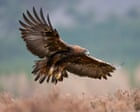
The reintroduction of the Golden Eagle (Aquila chrysaetos) to the English landscape represents a pivot from passive conservation toward active ecological engineering. While public discourse often focuses on the sentimental return of a lost icon, the technical reality is a complex negotiation between biological suitability, land-use economics, and the mitigation of anthropogenic risk. After an absence exceeding 150 years—interrupted only by a transient presence in the Lake District—the viability of a self-sustaining English population depends on three primary variables: prey density margins, habitat connectivity, and the elimination of persecution-based mortality.
The Trophic Cascade Framework
Reintroducing an apex predator is not an isolated event but a systemic intervention. The Golden Eagle functions as a regulator of mesopredators and smaller herbivores. To understand the impact of their return, one must analyze the Top-Down Control Mechanism.
- Suppression of Competitive Mesopredators: In environments where Golden Eagles are absent, smaller raptors and opportunistic carnivores such as foxes can experience population surges. The presence of an apex raptor creates a "landscape of fear," altering the behavior and distribution of these species, which can paradoxically benefit ground-nesting birds by reducing overall predation pressure.
- Carcass Availability and Scavenger Guilds: Golden Eagles are significant contributors to the scavenger economy. In winter months, their ability to locate and process large carrion provides high-energy resources for a secondary tier of scavengers, including buzzards and corvids.
- Herbivore Density Regulation: While eagles are generalist predators, their impact on rabbit and mountain hare populations (where applicable) acts as a stabilizing force, preventing localized overgrazing that can degrade floral biodiversity.
The bottleneck for this cascade in England is the Carrying Capacity Quotient. Unlike the Scottish Highlands, the English uplands are fragmented. The success of a reintroduction relies on the "Minimum Viable Area" (MVA) required for a breeding pair, typically ranging from 3,000 to 10,000 hectares depending on the biomass availability of the territory.
The Economic and Spatial Conflict Model
The primary friction point for reintroducing large raptors is the overlap between eagle hunting ranges and commercial land use. Specifically, the sheep farming and grouse moor industries represent significant stakeholders with competing interests.
The Livestock Interaction Variable
Data from existing populations in Scotland and the Alps indicate that while Golden Eagles do predate on lambs, the statistical impact is often lower than perceived. The conflict arises from the "Impact Concentration" effect: while the national loss might be less than 1%, a single farm located near a nest site can suffer disproportionate losses. A successful reintroduction strategy requires a Risk-Transfer Mechanism, moving from flat subsidies to a performance-based "Livestock Protection Payment" that compensates for verified losses while incentivizing coexistence.
Habitat Suitability and Anthropogenic Obstacles
The English landscape presents three structural hurdles that did not exist during the eagle's previous residency:
- Wind Energy Infrastructure: Modern wind farms create "displacement zones." Eagles, being soaring birds that rely on thermals and ridge-lift, are susceptible to collision risk or, more commonly, habitat loss as they avoid turbine arrays.
- Commercial Forestry Monocultures: While eagles require remote nesting sites, dense Sitka spruce plantations provide poor hunting grounds compared to open moorland or staggered woodland edges.
- Persecution and Illegal Poisoning: The historical driver of extinction was human-mediated mortality. The "Security Threshold" for a reintroduction is a juvenile survival rate exceeding 70%. If illegal poisoning or trapping persists in the North Pennines or the Peak District, the reintroduction becomes a "sink population," requiring constant artificial replenishment.
Demographic Modeling and Translocation Logistics
For a population to reach "Self-Correction Status," where births exceed deaths without human intervention, the initial founder group must possess sufficient genetic diversity. The logistics of translocation involve moving "donor" chicks from high-density regions (likely the Scottish Highlands or Scandinavia) to "release" sites.
The Sourcing Strategy follows a strict ethical and biological protocol:
- The "Second-Chick" Principle: In years of high prey abundance, eagle nests often produce two chicks, though the younger frequently fails to survive due to siblicide (Cainism). Harvesting the second chick for translocation minimizes the impact on the donor population.
- Soft Release vs. Hard Release: The preferred method is "hacking," where young birds are kept in aviaries at the release site and fed without human contact until they are fledged. This builds "site fidelity," increasing the likelihood that they will remain in the targeted English uplands rather than migrating back to their ancestral ranges.
The Bio-Technical Feasibility of the North Pennines
The North Pennines AONB (Area of Outstanding Natural Beauty) is frequently cited as the primary candidate for reintroduction. This is due to its high altitude, low human density, and its role as a bridge between the existing Scottish populations and the southern uplands.
However, the Ecological Matrix of the North Pennines is currently optimized for Red Grouse. This creates a high-density prey environment that is attractive to eagles but also a high-risk environment due to the history of raptor conflict on managed estates. The "Operational Success Metric" for the North Pennines will not be the number of birds released, but the number of successful nesting attempts recorded over a ten-year horizon.
The current strategy involves a phased approach:
- Phase I (Data Acquisition): Tagging "wandering" birds from the South of Scotland reintroduction project to map their flight paths into England. This identifies natural corridors.
- Phase II (Public-Private Partnership): Establishing legal frameworks with land managers to ensure that "Eagles on the Estate" is viewed as a mark of ecological prestige rather than a liability.
- Phase III (The Release Pulse): A concentrated release of 5–10 birds per year over a five-year period to establish a critical mass of breeding-age individuals.
Quantifying Success: Beyond Occupancy
Success in rewilding is often mismeasured by the presence of a species. A more rigorous analytical framework uses Functional Recovery Metrics.
| Metric | Definition | Target for England |
|---|---|---|
| Recruitment Rate | Number of fledglings per breeding pair per year. | >0.5 |
| Territory Saturation | Percentage of suitable habitat occupied by breeding pairs. | 40% within 20 years |
| Range Expansion | Annual increase in the distance of new nests from release sites. | 10km/year |
| Social Acceptance Score | Quantitative survey data from local agricultural stakeholders. | >60% Neutral/Positive |
The "Extinction Debt" of the English landscape is high. Reintroducing the Golden Eagle is an attempt to settle part of that debt, but it requires more than just biological release; it requires a reconfiguration of the rural economy.
The Strategic Path Forward
To ensure the Golden Eagle becomes a permanent fixture of the English sky rather than a temporary experiment, the focus must shift from the birds to the land-use policy. The following strategic actions are required:
- Implement a Natural Capital Valuation: Quantify the ecotourism value of the Golden Eagle for the North Pennines and Lake District. In the Isle of Mull, eagle-related tourism contributes over £5 million annually to the local economy. A similar model in England would provide the "Financial Buffer" necessary to offset agricultural friction.
- Establish "Raptor Safe Zones": Create corridors where the use of certain pesticides and lead ammunition is banned, and where illegal persecution carries severe, strictly enforced economic penalties for landholdings.
- Dynamic Prey Management: Work with the Forestry Commission to ensure that new woodland planting incorporates the open-canopy structures required for eagle hunting, avoiding the creation of "blind" forests where the birds cannot access prey.
The reintroduction of the Golden Eagle to England is technically feasible but politically and socially precarious. The biology is ready; the infrastructure of the English countryside is not. The success of this initiative will be the ultimate test of whether England can transition from a managed garden to a functioning ecosystem.