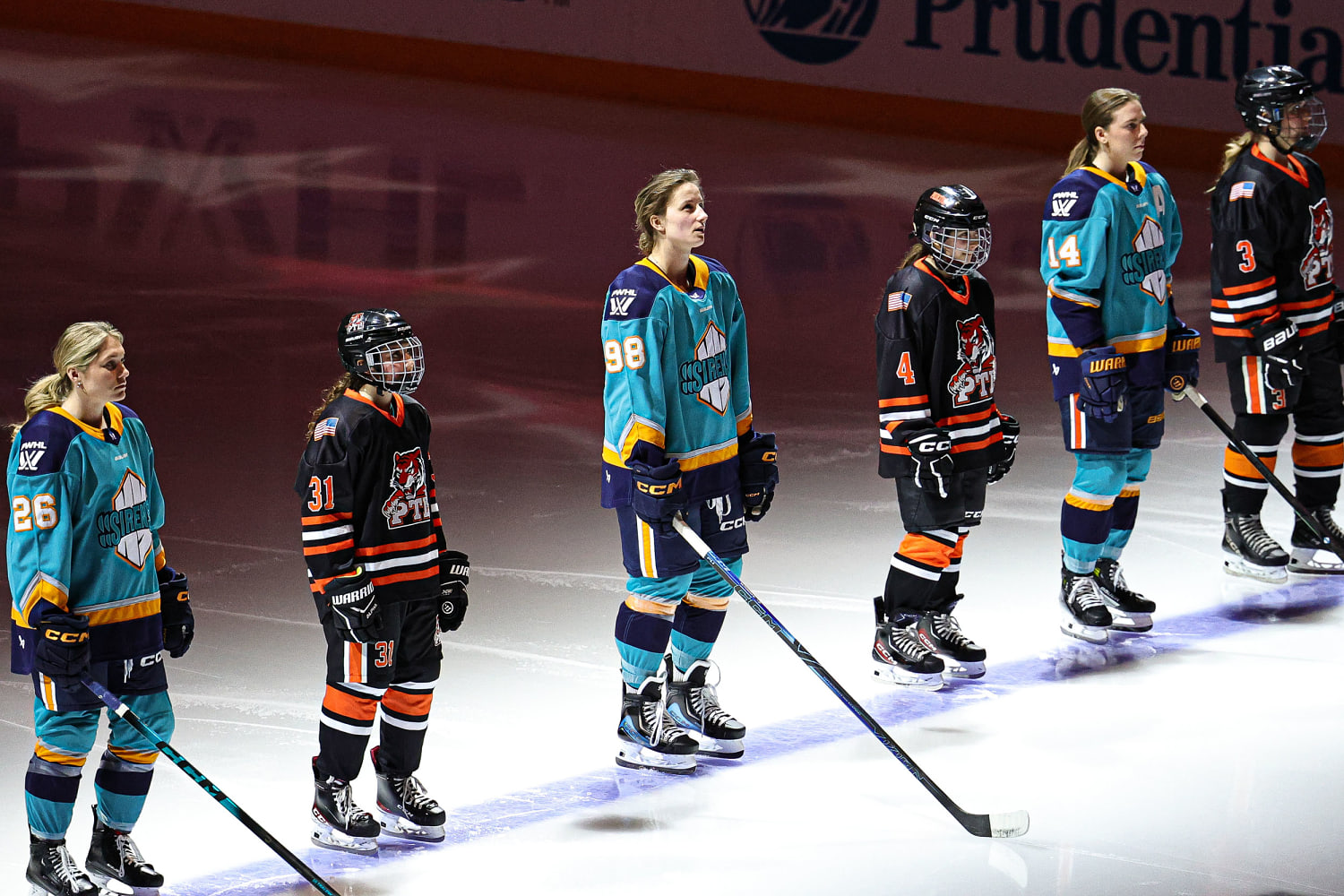
The light from the television screen used to be a cold, flickering blue for women’s hockey fans. It was the color of uncertainty. For decades, if you wanted to watch the best women in the world play the game they loved, you didn't just turn on the TV. You hunted. You navigated through glitchy YouTube streams with commentary in languages you didn't speak. You refreshed Twitter feeds to find a grainy link to a basement broadcast that might cut out during the power play. You existed in the margins.
Then the signal changed.
When the Professional Women’s Hockey League (PWHL) finally hit a major U.S. national broadcast, it wasn't just a win for the league's ledger. It was a moment of visibility that felt like someone had finally turned the stadium lights on after forty years of playing in the dark. To understand why a single broadcast matters, you have to look past the box scores and into the living rooms where a generation of girls had grown up believing their sports belonged in a different, quieter category than the men’s.
Consider a hypothetical fan named Maya. She is ten years old. She lives in a suburb outside of Boston or St. Paul. She spends her Saturday mornings shivering in a local rink, her ponytail tucked into a helmet, chasing a puck that feels heavier than it looks. When she gets home, she wants to see what the "endgame" looks like. She wants to see her future. Before this broadcast, that future was a ghost. It was something people talked about in hushed tones of potential and "someday."
But "someday" doesn't pay the rent. "Someday" doesn't sell out the Tsongas Center or Xcel Energy Center.
The transition to a major U.S. network means Maya doesn't have to go looking for the game. The game finds her. It sits on the same digital shelf as the NHL, the NBA, and the NFL. That proximity is the real revolution. When a sport moves from a niche streaming platform to a national broadcast, it stops being an "initiative" and starts being an industry.
The stakes were higher than the scoreboard suggested. If the broadcast failed—if the production values were low, the cameras shaky, or the commentary condescending—it would have reinforced the tired, cynical narrative that women’s sports are a charity case. But the PWHL didn't show up for a handout. They showed up with a product that was fast, physical, and visually arresting. The cameras captured the snow spraying off the blades, the frantic scramble in the crease, and the raw emotion of players who had spent years playing for five hundred people now realizing they were being watched by millions.
Money follows eyeballs. This is the brutal, honest gravity of professional sports. Advertisers who previously viewed women’s hockey as a risky "social good" investment suddenly saw a demographic that was engaged, loyal, and growing. The broadcast serves as a massive, loud proof of concept. It tells the brands and the billionaires that the audience wasn't hiding; it was just waiting for a reliable way to show up.
We often talk about "watershed moments" in sports history as if they are singular bolts of lightning. In reality, they are more like a dam finally breaking under the weight of a rising tide. The pressure had been building for years. It built through the 1998 Olympics, the 2018 gold medal run, and the many defunct leagues that came before this one. Each of those moments added a few more gallons to the reservoir.
The U.S. broadcast was the moment the concrete cracked.
There is a specific kind of silence that accompanies a game played in an empty arena. It’s a hollow sound that makes every skate blade on the ice feel lonely. For a long time, women’s professional hockey lived in that silence. The national broadcast replaces that void with the roar of a crowd that is finally synchronized. When a fan in Los Angeles can watch a goal scored in New York at the exact same moment as a fan in Chicago, a community is formed. That shared experience is the bedrock of sports culture. It’s what allows for the water-cooler talk, the viral highlights, and the tribal loyalties that sustain a league for decades.
This isn't about equality in a vague, abstract sense. It’s about the mechanics of respect. When a network commits airtime, they are making a bet on the viewer's attention. They are saying, "This is worth your time." For the players on the ice, many of whom have worked second jobs or lived out of suitcases just to keep the dream alive, that broadcast signal is a validation of their sweat. It is the sound of the world finally catching up to the talent that was always there.
Logic dictates that if you build it, they will come. But in the world of media, if you don't broadcast it, they can't see it. The PWHL’s arrival on American screens solved the visibility problem with a sledgehammer. The ratings weren't just "good for women's hockey." They were good, period. They challenged the gatekeepers who insisted there was no appetite for the game. They proved that the static was never in the sport itself—it was in the delivery.
The invisible stakes are found in the details. They are in the high-definition replays that show the technical precision of a blue-liner's footwork. They are in the pre-game shows that treat the players like the elite athletes they are, rather than curiosities. These details build a narrative of professionalism that bleeds into every aspect of the sport, from jersey sales to youth registration numbers.
The real magic, however, happens when the TV is turned off.
Maya finishes watching the game. She sees the sweat on the face of the captain. She sees the speed. She sees the intensity. She goes into her driveway with her stick and a plastic ball, and for the first time, she isn't just "playing hockey." She is mimicking a specific move she just saw on the big screen. She is imagining she is under those same bright lights. The distance between her driveway and the professional stage has suddenly shrunk from a thousand miles to the length of a remote control.
The broadcast did more than just show a game. It provided a map. It traced a path from the local rink to the national stage, illuminated by the glow of a million screens. The static is gone, and the picture has never been clearer.
The puck drops, the camera zooms in, and for the first time, nobody has to ask where to find the game. It is exactly where it belongs.