Roscosmos is not a space agency anymore. It is a logistics firm for state-sponsored mysticism.
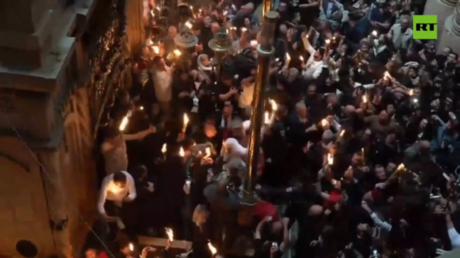
When the news broke that the Russian space agency flew the "Holy Fire" from Jerusalem to Moscow via a special flight, the media lapped it up as a heartwarming intersection of tradition and technology. They missed the funeral happening in the background. The spectacle of transporting a flickering candle across borders using aerospace-grade hardware isn't a "beautiful bridge" between faith and science. It is a desperate, calculated pivot.
If you are looking at this through the lens of cultural preservation, you are falling for the PR trap. This isn't about God. It’s about the fact that when your rockets stop winning the commercial market, you start selling the only thing left: national identity.
The Logistics of a Spiritual Stunt
Let’s talk about the physics. Transporting a live flame on an aircraft is a technical nightmare involving specialized Davy lamps and rigorous safety protocols. But the complexity isn't the point. The cost is.
Every hour a state-funded aircraft spends playing courier for a religious relic is an hour—and a massive budget line—diverted from actual orbital innovation. While SpaceX iterates on Starship and China builds a permanent presence on the lunar surface, Roscosmos is optimizing the "holy candle" supply chain.
I have spent years watching aerospace budgets dissolve into the ether. Usually, it's through simple mismanagement or corruption. This is different. This is the weaponization of nostalgia to distract from a lack of progress. When you can’t launch a competitive heavy-lift rocket, you launch a video of a priest blessing a Soyuz. It’s cheaper than R&D and much harder to criticize without looking like a cynic.
The Myth of the Pious Cosmonaut
The competitor articles love the narrative of the "spiritual explorer." They want you to believe that Russian rocket science has always been intertwined with the Orthodox Church.
Wrong.
The Soviet space program was aggressively, violently atheistic. Yuri Gagarin didn't look for God in the stars; he looked for orbital velocity. The current marriage between the Russian Orthodox Church and Roscosmos is a post-1991 shotgun wedding. It was designed to fill the ideological void left by the collapse of Communism.
By framing these flights as "sacred missions," the agency creates a shield. You can’t audit a miracle. You can’t question the ROI of a flight that carries the "Holy Fire." To do so is framed as an attack on the soul of the nation itself. It is the ultimate bureaucratic life hack: if your tech is failing, make your mission unfalsifiable.
Why the Tech World Should Be Terrified
This isn't just a Russian problem. It’s a symptom of a global trend where "Tech Theater" replaces "Tech Progress."
We see it in Silicon Valley with "consciousness-expanding" biohacking. We see it in the Middle East with "city of the future" renders that defy the laws of thermodynamics. When the actual engineering hits a wall—due to sanctions, brain drain, or simple lack of vision—agencies turn to the metaphysical.
Roscosmos is just the most honest about it. They aren't pretending to compete with the James Webb Space Telescope right now. They are competing with Sunday morning mass.
Consider the "Holy Fire" flight as a data point in a declining trajectory. The agency’s share of the global launch market has cratered. In the early 2010s, they were the only game in town for ISS taxi services. Now, they are a footnote in the commercial manifest.
The Cost of Symbolic Science
- Brain Drain: Top-tier engineers don't want to work for a cathedral; they want to work for a laboratory. When the mission statement shifts from "Mars" to "Miracles," the talent leaves for Pasadena or Hawthorne.
- Safety Erosion: Ritual is the enemy of the checklist. When the blessing of the rocket becomes as important as the pressure test, the culture of "no-fail" engineering begins to rot.
- Sanction Insulation: By leaning into religious nationalist PR, Roscosmos makes itself indispensable to the domestic political structure, even as it becomes irrelevant to the international scientific community.
Dismantling the "People Also Ask" Delusions
Does religious involvement help morale at Roscosmos?
Only if you define morale as "resignation to the status quo." True morale in an engineering firm comes from hitting milestones. Bringing the Holy Fire to Moscow provides a 24-hour dopamine hit of national pride that masks the 364 days of stagnant development.
Is it wrong for astronauts to be religious?
Individual faith is irrelevant. But when a state agency uses its primary assets to facilitate religious ceremonies, it is no longer an agency. It’s a ministry. The Soyuz was built to beat the Americans to the moon, not to act as a very expensive incense burner.
Doesn't this preserve culture?
Culture is preserved in museums and churches. Aerospace is about the future. If you try to build the future out of the materials of the 14th century, you end up with a museum that occasionally explodes on the launchpad.
The Brutal Reality of the New Space Race
We are currently in a period of "Splinternet" space exploration. The era of the International Space Station—a singular, globalized effort—is dying. In its place, we have fragmented blocks.
The Western block is driven by a chaotic mix of private capital and NASA’s deep-space ambitions. The Eastern block is increasingly centered around the CNSA (China), which is operating with a cold, secular efficiency that looks remarkably like the early Soviet program.
And then there is Roscosmos.
By leaning into the Holy Fire narrative, they have signaled their exit from the race. They are no longer trying to be the best; they are trying to be the most "authentic." In the world of high-stakes technology, "authenticity" is a consolation prize for the losers.
Imagine a scenario where a private company like Blue Origin or SpaceX spent $50 million to transport a religious artifact for the sake of "tradition." The shareholders would revolt. The engineering team would quit. The public would mock them. But because Roscosmos is a state-owned entity, we treat it as a "cultural nuance."
It’s not a nuance. It’s a white flag.
Stop Respecting the Spectacle
Every time a journalist writes about the "beauty" of the Holy Fire being delivered by the space agency, they are helping bury the lead. The lead is that the successor to Korolev and Glushko—the men who put Sputnik in the sky—is now a glorified delivery service for a flame that could be moved by a standard commercial courier for a fraction of the cost.
The fire isn't the story. The flight isn't the story. The story is the hollowed-out shell of a once-great titan trying to stay relevant by appealing to the pews because it can no longer appeal to the stars.
If you want to save Russian space exploration, you have to stop cheering for the candles. You have to start demanding the turbines. Anything less is just watching the light go out.
Go look at the launch manifest for the next three years. Count the number of scientific payloads. Then count the number of symbolic gestures. The math doesn't lie, even if the icons do.