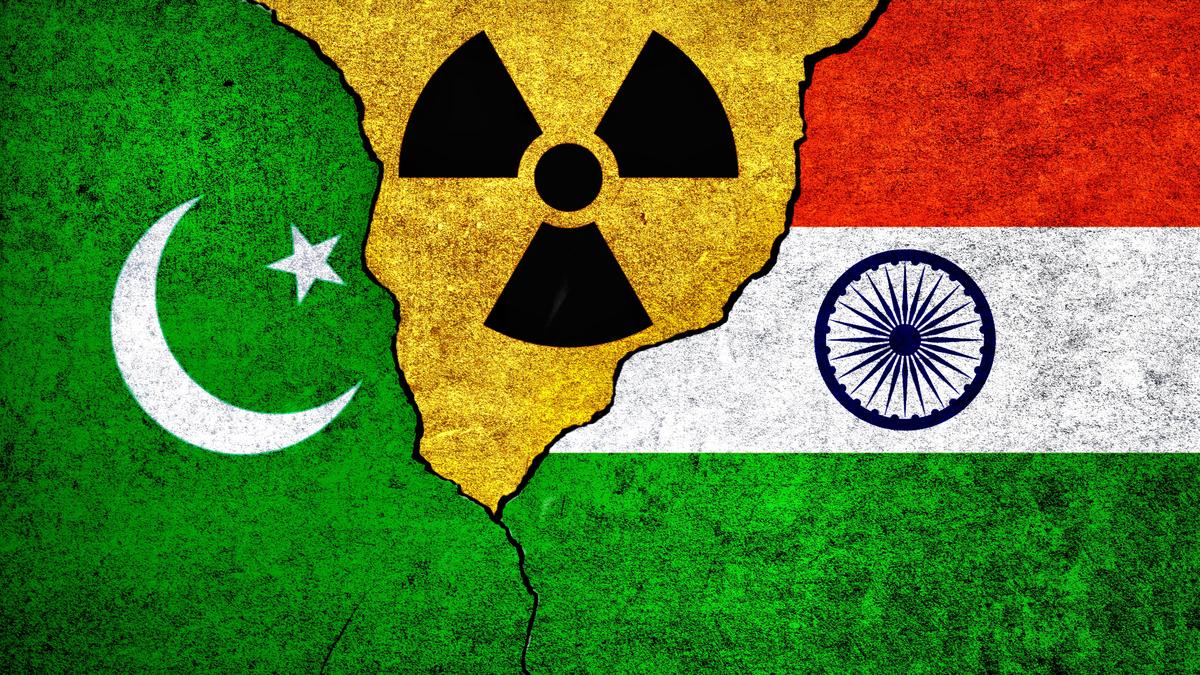
A red telephone sits on a desk in an office where the air conditioning hums at a constant, clinical frequency. It rarely rings. In the high-stakes theater of global diplomacy, we are taught to believe that as long as the lines are open, the world is safe. But the latest intelligence from the United States suggests that the wires are fraying. The silence between New Delhi and Islamabad is no longer the quiet of peace. It is the heavy, suffocating silence of a room filling with gas, waiting for a single, accidental spark.
When American intelligence officials released their annual threat assessment, the language was typically bureaucratic. They spoke of "volatile" ties and "persistent" risks. Yet, if you strip away the sterile phrasing, the message is visceral. For the first time in years, the threshold for a full-scale nuclear confrontation in South Asia is not just a theoretical math problem for academics. It is a living, breathing shadow over a fifth of the human population.
The Anatomy of a Hair-Trigger
Think of the border at Wagah. Every evening, soldiers from both India and Pakistan perform a choreographed dance of aggression—high kicks, stomping boots, and fierce glares—before lowering their respective flags. It is a spectacle of controlled hostility. For decades, this has been the metaphor for the entire relationship: loud, performative, but ultimately bound by a set of unwritten rules.
The rules are changing.
Intelligence analysts point to a shift in how both nations perceive "red lines." In the past, a border skirmish was a border skirmish. Today, the integration of advanced technology has compressed the time leaders have to make a decision. If a swarm of unidentified drones crosses the Line of Control, a general in Rawalpindi or a commander in New Delhi has minutes, not hours, to decide if this is a conventional provocation or the opening salvo of an existential strike.
Miscalculation is the ghost in the machine. It isn't that either Prime Minister Narendra Modi or his Pakistani counterparts wake up with the desire to initiate Armageddon. It is that the systems they command are becoming too fast for human intuition. When U.S. Intelligence warns of a risk of "miscalculation," they are describing a scenario where a glitch, a rogue commander, or a misunderstood military exercise spirals into a mushroom cloud before anyone can pick up that red telephone.
The Ghost of 2019
To understand the current dread, we have to look back at the Balakot airstrikes. When Indian jets crossed into Pakistani airspace following a devastating terror attack in Pulwama, the world held its breath. For a few frantic days, the two nuclear powers engaged in aerial dogfights. A pilot was captured. The rhetoric reached a fever pitch.
We survived that moment. But the lesson learned by both sides wasn't necessarily one of caution. Instead, it reinforced the idea that "limited war" under a nuclear umbrella is possible. This is the most dangerous delusion of the modern age. It is the belief that you can punch someone in the face without starting a riot.
The U.S. assessment suggests that under the current Indian leadership, the policy of "strategic restraint" has been retired. India is now more likely to respond to perceived provocations with military force. On the other side, Pakistan’s reliance on "tactical" nuclear weapons—smaller, battlefield-ready warheads—lowers the bar for nuclear use.
Imagine a local commander on a dusty plain, overwhelmed by an advancing conventional army, holding the keys to a weapon that can vaporize a city block. He isn't a strategist in a mountain bunker. He is a tired, frightened man with a manual.
The Invisible Stakes
We often discuss these conflicts through the lens of "geopolitics," a word that handily strips the humanity out of the horror. We talk about "payloads" and "yields" and "deterrence stability."
Consider a grandmother in Lahore. She is worried about the price of flour and whether her grandson will pass his exams. Consider a tech worker in Bengaluru, coding the next great app while sipping a latte. Neither of them spends their day thinking about the flight time of a Hatf-IX or an Agni-V missile. They shouldn't have to.
Yet, the intelligence report highlights that the internal instability within Pakistan—economic freefall and political upheaval—creates a vacuum. History shows us that when a state feels its internal grip slipping, it often looks for an external enemy to galvanize the masses. This isn't just a Pakistani problem. Nationalistic fervor in India, fueled by a 24-hour news cycle that treats war like a cricket match, creates a political environment where de-escalation is viewed as cowardice.
The "human element" here is pride. It is the one variable that no computer model can accurately predict.
The Role of the Watcher
Why is the United States the one sounding the alarm? It isn't out of pure altruism. A nuclear exchange in South Asia would trigger a global "nuclear winter" that would collapse harvests from Iowa to Ukraine. The soot from burning cities would rise into the stratosphere, blocking the sun for years.
But there is a more immediate, cynical reason for the warning. The U.S. is increasingly reliant on India as a counterweight to China. A distracted, scarred, or radioactive India is of no use to Washington's Pacific strategy. Conversely, a Pakistan that collapses into a failed state with an unsecured nuclear arsenal is the ultimate nightmare for global counter-terrorism units.
The intelligence community is essentially telling us that the safety net is gone. In previous crises, the U.S. acted as the "honest broker," sending high-level envoys to shuttle between capitals to cool tempers. But as global alliances shift and the U.S. pulls back from its role as the world's policeman, who is left to walk the two rivals back from the ledge?
The Mechanics of the Brink
The risk is compounded by the "modernization" of these arsenals. We aren't talking about the clunky bombs of the 1940s. We are talking about MIRVs—Multiple Independently Targetable Reentry Vehicles. One missile, multiple warheads, each hitting a different target.
This technology creates a "use it or lose it" mentality. If you believe your enemy has the capability to wipe out your entire arsenal in a single strike, you are incentivized to fire first at the slightest sign of trouble. It is a duel where both gunslingers have their fingers trembling on the trigger, convinced the other is about to blink.
The report doesn't say war is inevitable. It says the risk is persistent. That word, persistent, is doing a lot of heavy lifting. It means the danger has become part of the background noise of our lives. We have lived with the bomb for so long that we have forgotten it is there.
The Fragility of the Status Quo
There is a specific kind of arrogance in thinking that because a disaster hasn't happened yet, it never will. We look at the seventy-year history of the Indo-Pak conflict and see a series of crises that were managed. We see the 1965 war, the 1971 war, the 1999 Kargil conflict. We tell ourselves that these nations are experts at brinkmanship.
But luck is not a strategy.
The current environment is different. Social media now allows misinformation to travel faster than a diplomat can write a memo. A fake video of a border atrocity can go viral in minutes, sparking riots and demanding a military response before the facts are even established. We are trying to manage 21st-century tensions with 20th-century diplomacy.
The U.S. Intelligence assessment is a reminder that the most dangerous place on earth isn't a battlefield in Eastern Europe or a jungle in Southeast Asia. It is a specific stretch of border where two nations, bound by a shared history and a mutual suspicion, hold the power to end the world as we know it.
The Sound of the Future
If you go to the border today, you will still see the high kicks and the stomping boots. You will see the crowds cheering for their respective colors. It feels like a game. It feels like a tradition.
But behind the theater, in the darkened rooms where the radars sweep and the codes are kept, the margin for error is shrinking. The intelligence report isn't just a document for Congress; it is a flare sent up in the middle of a dark night.
We are living in the interval between the spark and the flame. The real story isn't the missiles or the treaties or the intelligence briefings. The real story is the millions of people living their lives in the shadow of a giant, hoping that the people in the clinical, air-conditioned rooms never have a reason to pick up the red phone.
The silence continues, for now. But it is the kind of silence that makes your ears ring, the kind that precedes a storm so great it leaves no one behind to tell the tale.