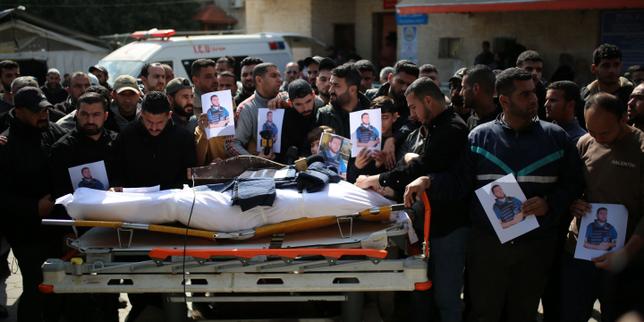
The death of Mohammed Washah, a journalist affiliated with Al-Jazeera, during an Israeli military operation in the Gaza Strip, functions as a critical case study in the breakdown of deconfliction protocols and the escalating lethality of modern urban warfare for non-combatants. This incident is not an isolated tactical event but a data point within a broader systemic failure of protective mechanisms designed to separate the press from active kinetic engagements. Understanding this event requires a decomposition of the operational environment, the technical nature of the strike, and the legal frameworks governing media personnel in high-intensity conflict zones.
The Triad of Conflict Zone Risk
The survival of a journalist in a contested urban environment depends on three primary variables: physical visibility, electronic signature management, and the reliability of deconfliction channels. When any of these pillars collapses, the probability of a fatal engagement increases exponentially.
- Physical Visibility vs. Target Identification: Journalists rely on standardized identifiers—blue vests and helmets labeled "PRESS." However, in a high-density urban battlefield characterized by rapid movement and long-range precision munitions, the visual confirmation of these identifiers by an operator or an automated targeting system is often delayed or bypassed by the speed of the engagement cycle.
- Signal Intelligence and Attribution: Modern militaries utilize signal intelligence (SIGINT) to identify clusters of electronic activity. Journalists, who must transmit large data packets via satellite or cellular networks to file reports, generate high-visibility electronic signatures. If a military actor classifies these bursts of data as command-and-control (C2) activity rather than media transmission, the site becomes a high-priority target for kinetic neutralization.
- Deconfliction Friction: The "Green Line" for media safety relies on the sharing of GPS coordinates with military headquarters. The failure of this system often stems from a latency gap between the high-level command (which holds the list of protected sites) and the tactical unit on the ground (which perceives a localized threat).
Mechanics of the Kinetic Engagement
The footage associated with the attack on Mohammed Washah provides a technical window into the specific nature of the strike. The precision and localized impact suggest the use of an air-to-ground munition designed for targeted neutralization rather than broad area suppression. This distinction is critical from an analytical standpoint because it indicates a deliberate selection of the target area based on intelligence, surveillance, and reconnaissance (ISR) data.
The "Kill Chain"—the process of finding, fixing, tracking, targeting, engaging, and assessing—in this instance appears to have been compressed. In dense urban terrain like Gaza, the time between target identification and weapon release is often less than two minutes. Within this window, the burden of proof for "non-combatant status" is frequently subsumed by the "necessity of strike" if the target is perceived to be in proximity to hostile assets.
The proximity variable is the most frequent cause of "collateral" fatalities. When journalists operate in the immediate vicinity of military infrastructure or personnel, they enter a zone where the distinction between a legitimate military target and a protected civilian becomes blurred by the physical overlapping of the two. This creates a "Risk Gradient" where safety is inversely proportional to the journalist's distance from active combatants.
Legal Definitions and the Combatant-Journalist Matrix
International Humanitarian Law (IHL), specifically the Geneva Conventions, classifies journalists as civilians. They lose this protected status only if they "take a direct part in hostilities." The controversy surrounding journalists in the Gaza conflict often hinges on the definition of "direct part."
- The Propaganda Threshold: Does the dissemination of information that supports a belligerent's narrative constitute a "direct part"? Under strict IHL interpretation, the answer is no. Ideological alignment or biased reporting does not strip a journalist of their civilian status.
- Logistical Integration: If a media worker utilizes military transport, resides in military housing, or uses military communication infrastructure, their status enters a legal gray zone. The challenge in the Washah case, and others like it, is the lack of third-party verification regarding the use of the site for non-journalistic purposes.
- Dual-Use Facilities: An office building used by a media outlet that also houses communication equipment used by a militant group becomes a "dual-use" target. In such scenarios, the military actor argues that the military advantage gained by destroying the facility outweighs the risk to the civilians within it—a principle known as proportionality.
The Cost Function of Information Sourcing
The attrition rate of journalists in this conflict is fundamentally tied to the information sourcing model utilized by international agencies. Because foreign journalists have been largely restricted from entering Gaza, the global news cycle depends entirely on local freelancers and staffers.
This creates a "Fixed Exposure" problem. Local journalists do not have the option to "rotate out" of the conflict zone. Their homes, families, and offices are situated within the theater of operations. Consequently, their exposure to kinetic risk is continuous, 24/7, whereas an embedded foreign correspondent typically experiences risk in discrete, time-limited intervals.
The reliance on local staff also complicates the "Trust Layer" between the military and the media. If a military actor views local journalists not as independent observers but as extensions of the local population (and by extension, the local government or militant groups), the psychological and operational barriers to engagement are lowered.
Quantifying the Deterrence Effect
The death of high-profile journalists like Washah creates a "Chilling Coefficient" within the media ecosystem. This is a measurable reduction in the volume and diversity of information exiting a conflict zone following a lethal incident.
- Operational Contraction: Media outlets may withdraw staff from high-risk sectors, leading to "black holes" in reporting where military actions occur without independent oversight.
- Self-Censorship of Movement: Journalists may avoid locations that are strategically significant—even if they are newsworthy—to prevent being caught in a strike directed at military assets.
- Digital Footprint Reduction: To avoid SIGINT targeting, journalists may reduce their use of electronic devices, resulting in delayed reporting and a loss of real-time situational awareness for the global audience.
This data vacuum benefits belligerents who prefer to control the narrative through official press releases rather than unfiltered visual evidence. The degradation of independent reporting acts as a force multiplier for military operations by reducing the risk of public outcry or legal scrutiny.
The Strategic Failure of Protective Protocols
The current state of deconfliction is a failed architecture. The reliance on voluntary notification and visual markers is insufficient in an era of drone-warfare and AI-augmented targeting. To move beyond the current cycle of "strike and apology," the protocol must shift toward a technical integration of safety.
This would require a "Digital Geneva Convention" for conflict zones, where media equipment is fitted with standardized, low-power transponders that broadcast a "Protected Status" signal on a dedicated frequency. This would move the burden of identification from the human eye to the targeting sensor, providing an automated "no-fire" override for precision weapon systems.
The limitation of such a system is the risk of spoofing by combatants, which brings the conversation back to the fundamental issue of trust. Until a technical or political mechanism can reliably separate the civilian signal from the military noise, journalists in high-intensity urban theaters like Gaza will remain unintended targets in a system optimized for lethality over distinction.
The operational reality dictates that media organizations must now treat their digital signature as their primary vulnerability. Future survival in these zones will depend less on the word "PRESS" on a vest and more on the ability to mask or authenticate communication bursts in a way that satisfies the threat-detection algorithms of modern militaries. The strategic recommendation for media entities is the immediate adoption of localized, low-burst transmission protocols and the abandonment of static "media hubs" in favor of highly mobile, decentralized reporting units that minimize the probability of being categorized as a fixed military target.


