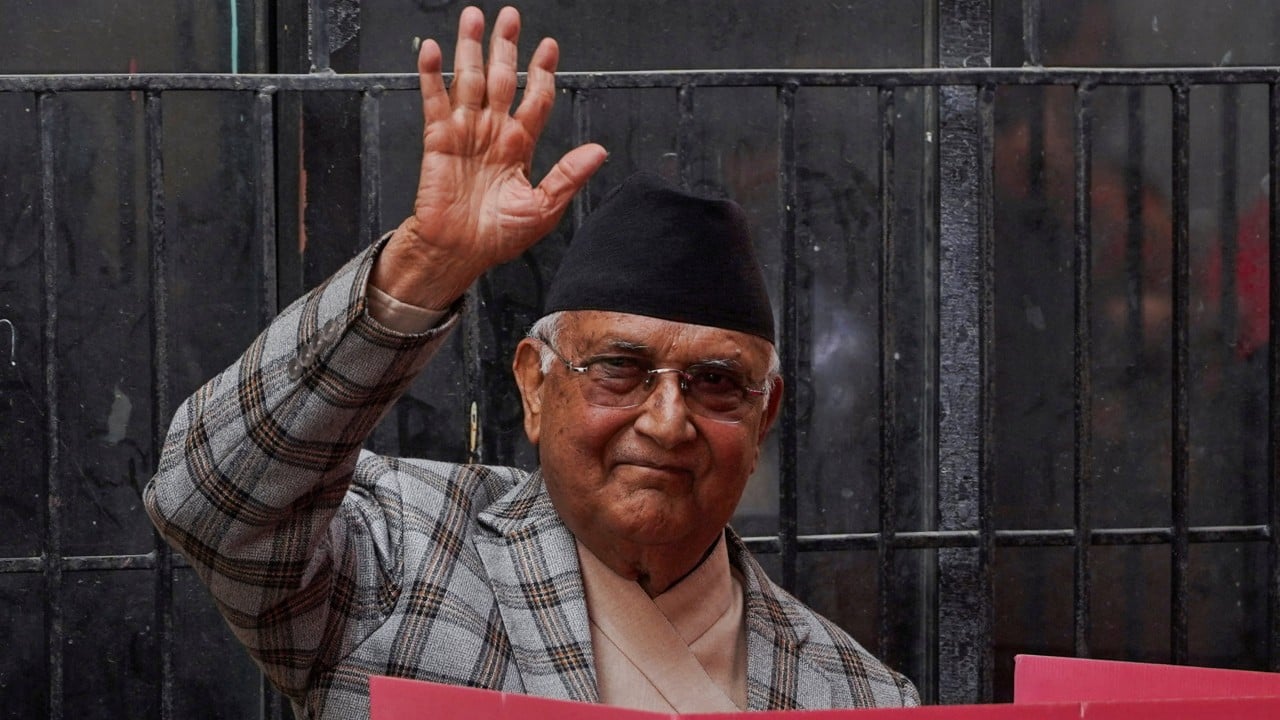
The air in Kathmandu usually carries the scent of burning juniper and exhaust, a thick, familiar blanket that settles over the valley as the sun dips behind the Himalayas. But on this particular evening, the atmosphere tasted of cold iron and quiet apprehension. K.P. Sharma Oli, a man who once moved through these streets with the gravity of a mountain, found the walls of his world suddenly closing in.
Power is a strange, liquid thing. One moment it is a flood, sweeping everything before it; the next, it evaporates, leaving only the dry, cracked earth of accountability. For the former Prime Minister, the transition happened with the sharp click of a car door and the somber faces of men who used to salute him.
The arrest of a titan is never just about a single man. It is about the ghost of every protester who stood in the wind, the memory of every baton that fell, and the slow, grinding gears of a democracy trying to find its pulse.
The Weight of a Decision
Imagine a young student in the heart of a protest, her breath coming in ragged gasps as the tear gas begins to bite. Let’s call her Maya. She isn't a politician. She isn't a strategist. She is just a person who believes that her voice should carry more weight than a piece of lead. In the height of the crackdowns under Oli’s administration, thousands of Mayas stood their ground.
When a leader decides how to handle a crowd, they aren't just managing a "situation." They are writing the future of a nation’s psychology. The allegations against Oli suggest a heavy hand, a preference for silence over dialogue. The legal system is now asking a simple, terrifying question:
Did the state become a weapon against its own reflection?
History doesn't view crackdowns as efficient management. It views them as scars. Every time a protest is met with disproportionate force, a thread is pulled from the social fabric. Eventually, the whole garment begins to unravel. The arrest of K.P. Sharma Oli serves as a needle trying to stitch that fabric back together, however painful the process might be.
The Loneliness of the High Office
There is a specific kind of silence that haunts the halls of power. It’s the silence of "yes-men" and the muffled echoes of distant grievances. To understand how we got here, we have to look at the psychology of the "Strongman."
Oli didn't start as a villain in the public eye. He was a nationalist, a man who stood up to external pressures and promised a "Prosperous Nepal, Happy Nepali." It was a seductive vision. But the distance between a balcony speech and the reality of a kitchen table is vast.
As the economy stuttered and internal party fractures widened, the "Strongman" approach shifted from a tool of progress to a shield for survival. This is where the human element becomes most tragic. A leader who loses touch with the vulnerability of their people eventually becomes a prisoner of their own ego long before the police ever arrive.
Consider the mathematics of a movement. It isn't linear. It’s exponential. You can suppress ten people easily. A hundred is harder. A thousand is a problem. But when you suppress a million dreams for a better life, you aren't just fighting a crowd. You are fighting time itself. And time always wins.
The Invisible Stakes
Why does this matter to someone sitting thousands of miles away, or even someone in a quiet village in the Terai who just wants their crops to grow?
It matters because justice is the only thing that keeps the peace from being a hollow truce. If a former leader can be held to account for the blood spilled on the pavement, it sends a signal to every future occupant of that office:
The chair is borrowed. The power is on loan.
The investigation focuses on the harsh measures used during various agitations—times when the streets of Kathmandu became a theater of friction. The technicalities of the law will deal with "command responsibility" and "excessive force," but the human core of the issue is about the right to exist in a public space without fear.
Democracy is often messy, loud, and incredibly frustrating. It’s a slow-motion conversation where everyone is shouting. The temptation for any leader is to simply turn off the microphone. But when you turn off the microphone, the people start to use their feet. And when they start to walk, no amount of steel can hold them back forever.
The Mirror of the Courtroom
Now, the man who once held the gavel is watching it fall from the other side of the bench.
The legal proceedings aren't just a trial of a person; they are a trial of a period. It is an autopsy of a government’s soul. Evidence will be presented—orders signed, radio logs recorded, hospital records of the injured stacked high in manila folders. Each document is a silent witness to a moment where a choice was made.
Choice.
That is the word that haunts these halls. At any point, the path could have been different. De-escalation. Compromise. Humility. Instead, the path of the "Iron Fist" was chosen, and the problem with an iron fist is that it eventually rusts.
The Ghost in the Machine
The arrest has sent ripples through the political corridors of South Asia. It’s a reminder that the "Tapestry of Power"—wait, let’s call it what it is—the raw, bleeding reality of governance is fraught with peril. There are no safe exits for those who ignore the human cost of their ambition.
Think of the police officers who were told to charge. Think of the families of those who never came home from the rallies. Their stories are the footnotes in the official reports, but they are the main characters in the reality of this arrest. For them, this isn't about party lines or geopolitical shifts. It’s about a late, cold validation.
It’s about the fact that their pain finally has a name and a face in the eyes of the law.
The sun has long set over Kathmandu now. The city is breathing, its lights flickering like embers in the dark. K.P. Sharma Oli sits in a room that is much smaller than the ones he is used to. Outside, the world moves on, but it moves differently today.
There is a new weight in the air. It’s the weight of a precedent being set. It’s the realization that no one is so high that the ground cannot reach them.
The mountains remain. They have seen kings fall, and they have seen republics rise. They have seen the blood in the streets wash away with the monsoon rains, only for the truth to grow back like weeds through the cracks in the pavement. They are the only ones who are truly permanent.
The rest of us are just passing through, trying to make sure that when we leave, the world is a little less afraid of the men in the high towers.
The iron tower didn't just shake. It finally realized it was made of nothing but shadows and the consent of the people it tried to break.