Min Aung Hlaing’s transition from junta chief to self-appointed President of Myanmar is a hollow rebranding designed to mask a military institution in freefall. On April 10, 2026, the man who steered the nation into a bloody civil war stood before a hand-picked parliament to declare a "new era" of democracy and peace. However, the reality outside the capital of Naypyidaw tells a far grimmer story of territorial loss, economic ruin, and a desperate, failing diplomatic charm offensive aimed at ASEAN.
The primary goal of this move is simple: to trade a general’s uniform for a civilian suit in hopes that Southeast Asian neighbors will find it easier to look the other way. By formalizing his grip through a series of staged elections held over the last few months, Min Aung Hlaing is betting that "President" is a title that buys a seat back at the table. It is a gamble that ignores the fact that his military, the Tatmadaw, now controls less than half of the country.
The Geography of a Collapsing Regime
While the official ceremony in the capital was choreographed to perfection, the military's actual footprint in Myanmar has shriveled to its lowest point in decades. Since late 2024, the regime has suffered humiliating defeats in the borderlands. The loss of the Northeastern Command in Lashio and the Western Command in Rakhine State were not just tactical setbacks; they were symbolic gut-punches to an army that once considered itself invincible.
Current intelligence suggests the junta maintains firm control over only about 21% of Myanmar's territory. The rest is either a patchwork of zones held by Ethnic Armed Organizations (EAOs) and People’s Defense Forces (PDFs) or remains under heavy contest.
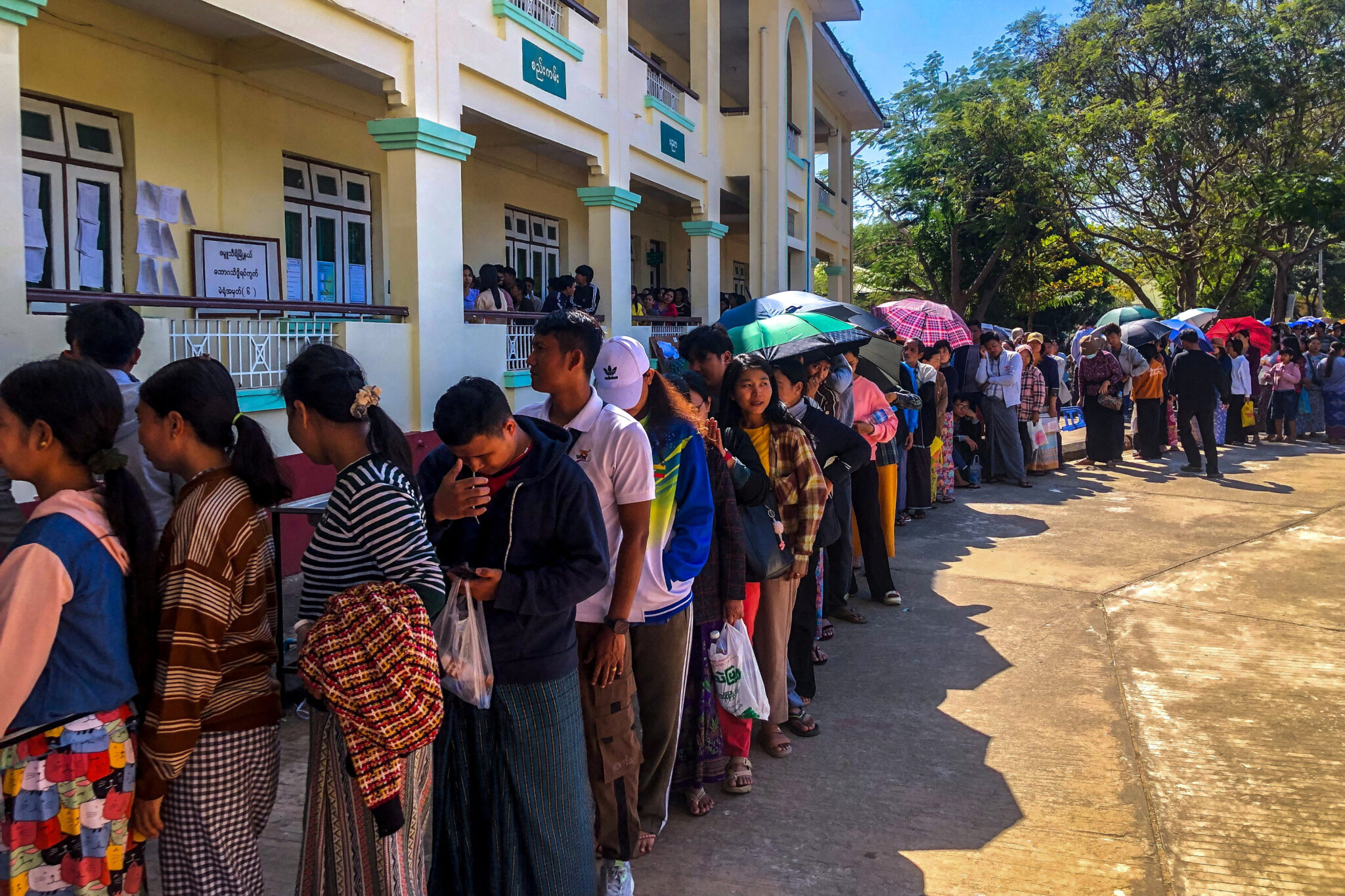
This territorial contraction has direct consequences for the "elections" Min Aung Hlaing uses to justify his presidency. Voting was impossible in over 60% of the country. In many townships, the only people who "voted" were those living within range of military artillery. This is not a democratic transition; it is a retreat into a fortress.
The ASEAN Wall and the China Lifeboat
The centerpiece of the new President's inaugural address was a plea for "normalized relations" with ASEAN. For five years, the bloc has kept Myanmar at arm's length, barring junta leadership from high-level summits due to their failure to implement the Five-Point Consensus. Min Aung Hlaing is banking on the "new government" label to bypass these restrictions.
He is likely to be disappointed. Philippine Foreign Minister Maria Theresa Lazaro, currently serving as the ASEAN special envoy, has already signaled that the name change does not change the facts on the ground. The bloc remains deadlocked. Some members, like Thailand and Laos, favor engagement to protect trade and border security, while Indonesia and Malaysia remain steadfast that a general in a suit is still a general.
The real power play, however, is not in Jakarta or Bangkok, but in Beijing. Min Aung Hlaing’s visit to China in late 2024 was a turning point. China has moved from "cautious observer" to "de facto supporter" of the junta’s electoral roadmap. Beijing wants stability at any cost to protect its strategic pipelines and the China-Myanmar Economic Corridor (CMEC).
Why China is Backing the "Sham"
- Asset Protection: Billions in Chinese infrastructure are at risk in rebel-held areas.
- Border Security: The flow of refugees and the spillover of fighting into Yunnan province is a headache for the CCP.
- Geopolitical Leverage: A weak, isolated Myanmar is a Myanmar that remains firmly in China’s orbit, regardless of who is in the palace.
An Economy in the ICU
Beyond the political theater, the economic cost of the civil war is staggering. Myanmar’s currency, the Kyat, has effectively ceased to be a reliable medium of exchange in international trade. To fund his war machine, Min Aung Hlaing has resorted to desperate measures:
- Forced Conscription: A February 2024 law is being used to drag young people off the streets to fill the thinning ranks of the Tatmadaw.
- Extortionate Business Fees: New registration requirements for political parties and businesses are essentially a shake-down for foreign currency.
- Resource Stripping: Rare earth mining and timber exports to China are being accelerated with zero environmental oversight to generate quick cash for ammunition.
The exodus of foreign investors since the 2021 coup—including giants like TotalEnergies and Chevron—has left a vacuum filled by shadowy middle-men and illicit trade. The economy is now a "war economy," where the only growth sectors are arms procurement and the smuggling of narcotics and people.
The Illusion of Peace
Min Aung Hlaing’s speech lasted only 18 minutes. It lacked a single concrete detail on how he intends to stop the fighting. He spoke of "peace" while his air force continues to conduct daily strikes on civilian centers in Sagaing and Kayah State.
The military's strategy is no longer to win the heart of the nation; it is to punish the population into submission. The activation of the conscription law has backfired, driving thousands of young Bamars—the country’s majority ethnic group—into the arms of the resistance. This is no longer just a peripheral conflict; the Bamar heartland is in open revolt.
The resistance is also evolving. The National Unity Government (NUG) and various EAOs are increasingly coordinating their offensives. While they are not a monolithic force, they share a singular goal: the total removal of the military from politics.
Min Aung Hlaing’s presidency is a survival tactic. By wrapping the junta in the vestments of a civilian government, he hopes to create enough ambiguity to fracture international opposition. He is betting that the world is tired of the Myanmar crisis and will accept a "stable" dictatorship over a "chaotic" revolution. But as the resistance gains ground and the military loses its grip on the borders, the "President" may find that his new title comes with a very small, very isolated kingdom.
The path to restoring ties with ASEAN does not run through a rigged ballot box in Naypyidaw. It runs through a genuine dialogue with the NUG and the release of political prisoners like Aung San Suu Kyi and U Win Myint—steps this new "President" has shown no intention of taking. Until then, the suit is just a costume, and the presidency is just a siege by another name.