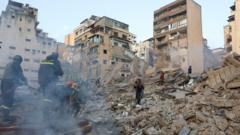
The sound of a precision missile hitting a high-rise in a crowded residential district isn't something you forget. It’s a sharp, metallic crack followed by a pressure wave that blows out windows for blocks. When Israel strikes and destroys a building in the heart of Beirut, it isn't just about the concrete and rebar coming down. It's a loud, violent signal that the old "rules of engagement" are dead.
For years, there was an unspoken understanding. Hezbollah stayed in the south or the suburbs, and Israel kept its heavy ordnance away from the cosmopolitan center of the Lebanese capital. That’s over. By hitting targets in neighborhoods like Bachoura or the central commercial districts, Israel is betting that total pressure will force a collapse in Hezbollah’s command structure. But on the ground, the reality is much messier. People who thought they were safe because they weren't near a military depot are suddenly finding themselves in the middle of a war zone. Meanwhile, you can find similar events here: The Cold Truth About Russias Crumbling Power Grid.
The end of the red lines in Lebanon
We used to talk about "red lines" as if they were physical barriers. They weren't. They were just patterns of behavior that both sides followed to avoid a total regional meltdown. When the Israeli Air Force decided to drop a building in central Beirut, they effectively told the world that no coordinate in Lebanon is off-limits. This isn't just about the Dahiyeh anymore. We're seeing strikes in areas filled with hospitals, embassies, and the everyday bustle of Lebanese civilian life.
The strategic shift is clear. Israel is no longer content with "mowing the grass" or simply degrading border capabilities. They're going for the head. By targeting specific offices or residential apartments used by coordination cells in the city center, they're trying to paralyze the communication between Hezbollah's political wing and its fighters. Does it work? Militarily, maybe. Psychologically, it’s a gamble. It creates a sense of omnipresent fear that can either break a population’s will or harden their resolve into something much more dangerous. To see the complete picture, we recommend the excellent report by Associated Press.
What these central strikes actually hit
When a building goes down in a dense urban environment, the "collateral damage" isn't just a statistic. It’s the pharmacy next door. It’s the family living two floors below the intended target who had no idea their neighbor was on a hit list. In recent strikes in the heart of Beirut, the target is often a specific floor or a basement unit. But 2,000-pound bombs don't do "specific" very well when it comes to structural integrity.
The Lebanese Ministry of Health and international observers like Human Rights Watch have been tracking the fallout. The numbers are grim. We're seeing hundreds of civilian casualties in areas that have no visible military infrastructure. This creates a massive internal displacement crisis. People are fleeing the south only to find that the "safe" apartments they rented in Beirut are now in the crosshairs. It’s a nomadic existence defined by fear.
The intelligence gap and the risk of error
You have to wonder where the data comes from. High-level assassinations require perfect intelligence. But as we've seen in past conflicts in Gaza and Lebanon, intelligence isn't infallible. When a strike happens in a crowded district like Hamra or Bachoura, a 10-meter margin of error is the difference between hitting a commander and wiping out a daycare.
The Israeli Defense Forces (IDF) claim they use roof-knocking or localized warnings. In the heart of Beirut, that’s rarely the case. The speed of these operations suggests they're prioritized for "time-sensitive targets." Basically, they see a window of opportunity and they take it, regardless of the surrounding density. This "strike first, explain later" policy is what has the international community on edge.
Lebanon's infrastructure is screaming
Lebanon was already a failed state before the first missile hit. The economy was a wreck, the port was in ruins from the 2020 blast, and the government was a ghost. Now, these strikes are hitting the few functional parts of the city left. When you destroy a building in the city center, you aren't just losing housing. You're cutting fiber optic cables. You're bursting water mains that serve thousands. You're making the city uninhabitable for the long term.
The Lebanese Army stands by and watches. They don't have the air defense to stop an F-35. They don't even have the political mandate to try. It’s a surreal scene: a national military that essentially acts as a cleanup crew for a war it isn't officially fighting. This power vacuum is exactly what Hezbollah thrives in, yet it’s also what Israel is trying to exploit. It’s a mess of contradictions that usually ends with the most vulnerable people paying the bill.
The ripple effect across the Middle East
Don't think Tehran isn't watching every frame of this footage. The heart of Beirut is a symbol. If Israel can operate there with impunity, it sends a message to every other Iranian proxy in the region. "Your capitals are not safe." This is psychological warfare as much as it is kinetic.
However, there’s a tipping point. Every time a landmark building in Beirut turns into a pile of gray dust, the pressure on Iran to respond directly increases. We're playing a high-stakes game of "chicken" where the road is a city of two million people. Regional experts from the Carnegie Middle East Center have pointed out that this escalation cycle has no clear exit ramp. Israel wants a buffer zone and a neutralized Hezbollah. Hezbollah wants to survive and keep firing. Neither of those goals involves Beirut being left in peace.
Understanding the displacement nightmare
Right now, schools in Beirut are packed. Not with students, but with refugees from the south. When the city center gets hit, these people have nowhere left to go. They've already run once. This creates a friction point within Lebanese society. Different sects and political groups are being forced into tight quarters under the stress of constant bombardment. It’s a tinderbox. Israel’s strategy might be to turn the population against Hezbollah, but history shows that shared trauma often does the opposite.
The logistics of urban warfare in 2026
Modern strikes use GBU-39 Small Diameter Bombs or JDAM kits to try and limit the spread of fire. But "limit" is a relative term. In a city built with narrow streets and aging infrastructure, the vibration alone can bring down the building next door. We're seeing a terrifying display of tech where a drone can track a cell phone into a bedroom and a jet can put a missile through the window ten minutes later.
If you’re trying to make sense of the news, look past the headlines about "terrorist infrastructure." Look at the maps. See how close these strikes are to the Lebanese Parliament, to the American University of Beirut, to the places where life is supposed to happen. When the heart of a city is hit, the pulse of the entire country skips.
Stop looking for a quick resolution. This isn't a "limited operation" anymore. It's a full-scale attempt to redraw the power dynamics of the Levant. If you're following this, pay attention to the flight patterns over the Mediterranean and the diplomatic cables coming out of Washington. The US has been calling for "de-escalation" while providing the very munitions used in these strikes. It’s a policy of "yes, and" that keeps the fire burning.
Stay updated by checking independent live maps like Lebanon's National News Agency or reputable regional trackers. Don't rely on single-source military briefings. The truth of what happens when a building falls in the heart of Beirut is usually found in the rubble, not the press release.