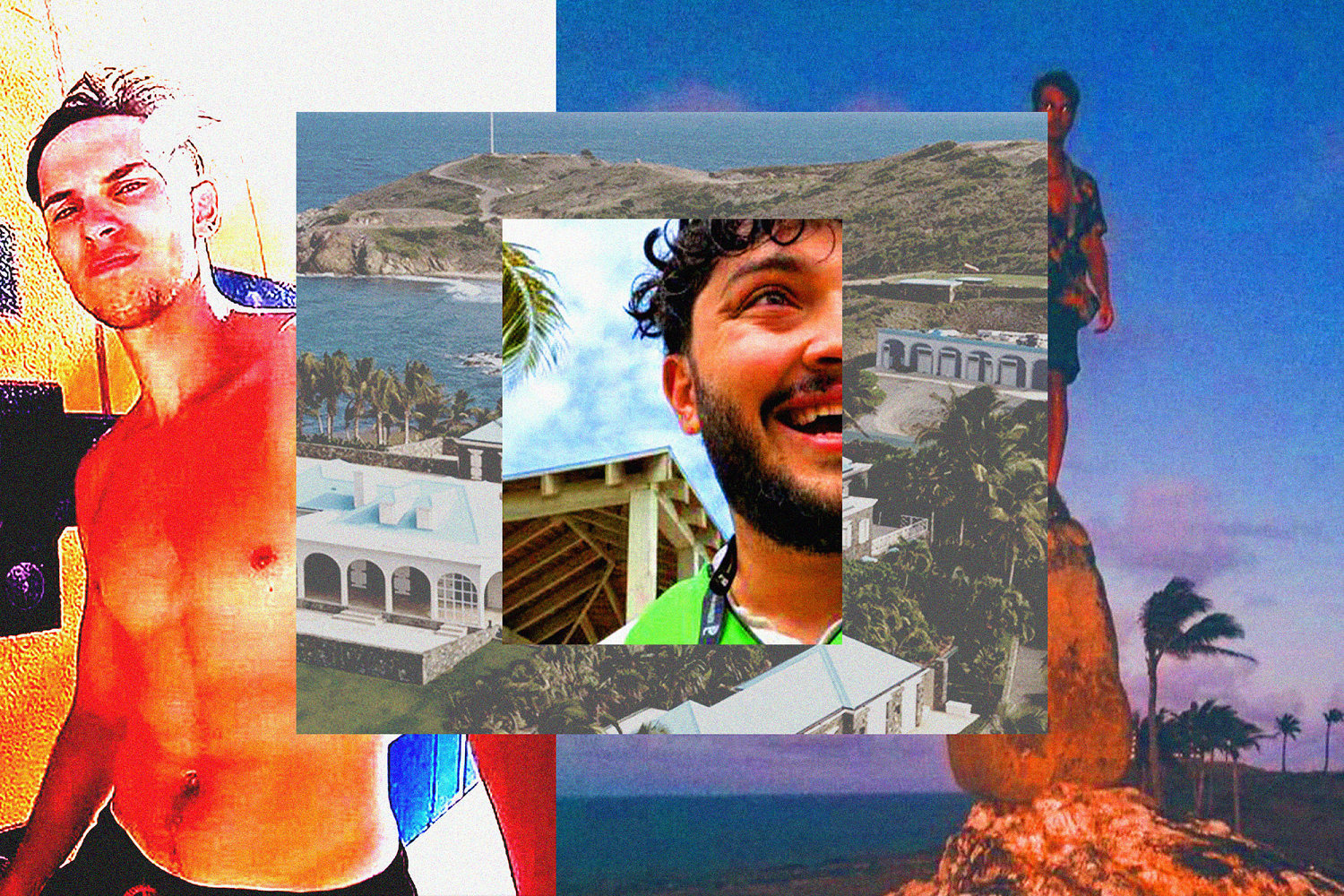
The water surrounding the United States Virgin Islands is a shade of blue that feels like a lie. It is too bright, too clear, too inviting. It is the kind of blue that promises renewal. But as the boat draws closer to the two hundred or so acres of land known as Little St. James, the color starts to feel like a shroud.
There is a specific type of silence that hangs over a crime scene after the yellow tape has weathered away. It isn't the peaceful quiet of nature. It is the heavy, expectant hush of a place that hasn't finished telling its secrets. Recently making headlines lately: Why Renting for Under £1000 a Month is Getting Harder in 2026.
Then, the shutter clicks.
A young man in expensive linen shorts adjusts his tripod. He checks his lighting. He is worried about the glare coming off the infamous "temple" with its painted blue stripes and gold-domed roof. He isn't here to mourn. He isn't here to investigate. He is here because the algorithm rewards the macabre, and nothing harvests engagement quite like the backdrop of a nightmare. Further information regarding the matter are detailed by Cosmopolitan.
The New Dark Tourism
We used to call it "Dark Tourism." People would visit Chernobyl or the killing fields of Cambodia to touch the hem of history, however tattered and bloodstained. There was usually a somberness to it—a quiet acknowledgment of human capacity for evil. But the digital age has stripped away the gravitas. Now, we have "Clout Tourism."
The influencers landing their private charters or hired skiffs on the shores of Jeffrey Epstein’s former island aren't looking for historical context. They are looking for a thumbnail.
Since the death of Epstein and the subsequent conviction of Ghislaine Maxwell, the island has sat in a state of expensive decay. For years, it was a fortress of shadowed elite power. Now, it is a playground for TikTokers. They sneak past security. They fly drones over the stone mansions. They pose in front of the sundial.
They are treating a site of systemic, generational trauma as if it were an abandoned Six Flags.
The Ghost in the Machine
Consider the mechanics of a viral video. You need a hook. You need a "vibe." On Little St. James, the hook is built-in. You don't have to explain why the location is significant; the name Epstein carries a visceral, dark electricity that spikes retention rates.
When a creator stands on that pier—the same pier where terrified minors were once ferried in secret—and tells their audience to "like and subscribe for part two," something fundamental breaks in our collective empathy. The island is no longer a monument to victims. It is a stage set.
The invisible stakes here aren't about trespassing laws or property rights. The real cost is the Dilution of Horror. When we see a twenty-something doing a "fit check" in a place where lives were systematically dismantled, the edge of that tragedy dulls. We begin to view the suffering of others as a mere aesthetic choice.
The Architecture of a Predator
Walking through the descriptions of the island provided by those who have breached its perimeter, you see the remnants of a very specific kind of ego. There are the statues of birds. There is the massive, industrial-grade gym. There are the underground tunnels that have fueled a thousand conspiracy theories.
The influencers focus on the tunnels. They want to find the "evidence" that the FBI supposedly missed. They crawl through the darkness with their phone flashlights, narrating their heart rates to their followers.
But the "truth" of the island isn't hidden in a secret basement. It’s sitting right there in the open. It’s in the audacity of the temple’s fake windows. It’s in the way the entire island was terraformed to be a private kingdom where the rules of the mainland didn't apply.
The creators filming there think they are being edgy. They think they are "exposing" the darkness. In reality, they are just the latest group of people using the island for their own gain. The motive shifted from predatory power to digital vanity, but the island remains a place where people go to take what they want without asking for permission.
The Feedback Loop
Why do we watch?
We can blame the influencers for their lack of taste, but the digital economy is a democracy. They go to the island because we click. We want to see inside the forbidden gates. We have a morbid curiosity that demands to be fed, and the "Explore" page is an all-you-can-eat buffet.
There is a psychological phenomenon at play here. By watching someone "conquer" the island via a vlog, we feel a sense of justice or closure that the legal system failed to provide. If a teenager with a GoPro can walk where the powerful once hid, then the powerful have lost their grip.
But it’s a false catharsis.
The victims of the Epstein network don't find peace because a YouTuber found a discarded chair in a guest house. If anything, the constant voyeurism forces them to see their trauma rebranded as "content" every time they open an app. The island becomes a recurring character in a never-ending season of True Crime theater.
The Erosion of the Sacred
There is a reason we don't hold fashion shoots at Auschwitz. There is a reason we don't film prank videos at the 9/11 Memorial. Some ground is meant to be heavy.
Little St. James is currently in a Limbo state. It was recently sold to a billionaire financier who reportedly intends to turn it into a luxury resort. This brings its own set of ethical nauseas. How do you drink a mojito on a patio where such profound cruelty was orchestrated? How do you sleep in a room that was once a prison in all but name?
But until the bulldozers arrive, the ghouls will keep coming.
They will continue to jump the fences. They will continue to use drone shots of the turquoise water to pad their transition sequences. They will continue to talk about "bad vibes" while actively profiting from the very energy they claim to find disturbing.
The View from the Water
If you sit on a boat a few hundred yards off the coast, the island looks idyllic. From a distance, you can’t see the peeling paint or the rusted equipment. You can’t see the influencers posing by the palm trees. You just see a green jewel in a sapphire sea.
It’s easy to look at it and forget.
That is the ultimate danger of the viral video. It turns a location into a caricature. It takes a complex, painful, and ongoing story of human suffering and shrinks it down to a 9:16 aspect ratio. It makes the island feel small. It makes the tragedy feel like it belongs to the past, something "cool" to go look at, like a shipwreck or a haunted house.
But the water doesn't wash it clean.
The influencers eventually pack up their gear. They head back to St. Thomas or fly home to Los Angeles to edit their footage. They add the dramatic music. They color-grade the sunset. They post the video and watch the numbers climb.
Behind them, the island remains. The wind whistles through the stripes of the temple. The waves lap against the pier. And the silence returns—heavy, dark, and entirely unconcerned with how many likes it gets.
The camera lens provides a filter, a way to stare at the sun without blinding yourself. But when the screen goes black, the sun is still there. The island is still there. And the people who were hurt there are still waiting for a world that cares more about their dignity than a viral thumb-stop.
The boat turns away, leaving the shore behind. The bright blue water churns into a white wake, a temporary scar on the surface of the sea that disappears almost as soon as it is made.