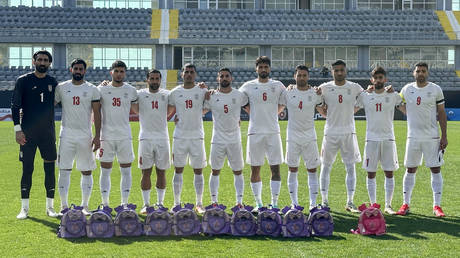
The intersection of professional athletics and high-stakes geopolitical conflict creates a unique communication channel where symbolic gestures function as non-verbal diplomatic communiqués. When the Iranian national football team utilizes a public platform to honor schoolchildren killed in a suspected strike, the event transcends simple mourning. It represents a calculated alignment of soft power assets—national athletes—with a specific narrative of victimization and state-sanctioned grief. Analyzing this event requires stripping away the emotional veneer to examine the structural mechanics of state-sponsored messaging, the psychology of collective mourning in authoritarian contexts, and the ripple effects within international sporting bodies.
The Triad of Symbolic Mobilization
State-aligned athletic gestures operate within three distinct functional pillars. Understanding these pillars reveals why a football pitch becomes a theater for political signaling.
- Narrative Consolidation: The primary objective is to solidify a specific causal link in the public consciousness. By associating the faces of national sports heroes with the victims of an external strike, the state bridges the gap between abstract military conflict and the personal lives of the citizenry. The athletes serve as the emotional conduits for state grievances.
- Internal Legitimacy: In regions facing internal friction, projecting a unified front through a universally loved medium—football—serves to dampen domestic dissent. The "rally 'round the flag" effect is intensified when the focus is shifted toward the tragic loss of non-combatant children, a demographic that commands universal sympathy across political divides.
- International Moral Leverage: On the global stage, these gestures aim to shift the "aggressor-victim" dichotomy. By utilizing the visibility of FIFA-sanctioned or high-profile international friendly environments, the Iranian apparatus attempts to bypass traditional diplomatic blockades and speak directly to a global audience.
The Cost Function of Political Expression in FIFA Frameworks
Athletes and federations do not operate in a vacuum; they function within a rigid regulatory environment governed by FIFA and regional confederations. Specifically, Law 4 of the Laws of the Game prohibits "political, religious or personal slogans, statements or images." The decision to engage in a tribute regarding a suspected US strike involves a complex cost-benefit calculation.
The Risk of Sanction is weighed against the Internal Reward. For the Iranian Football Federation (FFIRI), the threat of fines or match bans from FIFA is often viewed as a manageable operational cost when compared to the domestic necessity of demonstrating national solidarity. The mechanism of the tribute—whether it is black armbands, a moment of silence, or specific jersey inscriptions—determines the severity of the regulatory response.
Subtlety acts as a shield. A moment of silence for "victims" is technically harder to penalize than a banner explicitly naming a foreign government. This creates a cat-and-mouse game between the political objectives of the federation and the neutrality mandates of international sports governing bodies.
Attribution Complexity and the Information Gap
The core of the controversy lies in the "suspected" nature of the strike. In modern asymmetrical warfare, attribution is rarely immediate or undisputed. This creates an Information Asymmetry that state actors exploit.
- Fact-Finding Bottlenecks: Independent verification of strike origins in high-conflict zones typically lags behind the speed of social media and public protests. This delay is the prime operational window for athletes to set a narrative.
- The Narrative Primacy Effect: Once a national team associates a specific strike with a specific antagonist (the US in this case), the initial emotional resonance is significantly more difficult to undo than the subsequent presentation of technical forensic evidence.
The Iranian team’s tribute is thus a proactive strike in the informational domain. Even if a later investigation reveals ambiguity or complex tactical context, the image of the "fallen schoolchildren" is now inextricably linked to the "national heroes."
The Impact on Global Sports Diplomacy
When international athletes take a stand on military conflict, it triggers a cascade of diplomatic repercussions. The second-order effects of this particular Iranian football tribute can be analyzed through a strategic lens:
Deterioration of the Sport-as-Neutral-Ground Doctrine
The long-held belief that international sports should remain a "demilitarized zone" for diplomacy is eroded. Each state-sponsored tribute lowers the barrier for other nations to use their athletic assets for similar ends. This leads to the Politicization of the Pitch, where every pre-match ritual becomes a scrutinized ideological statement.
Sanction-Response Loops
If international bodies penalize the Iranian team for their tribute, it provides the state with a new grievance: the "silencing of national grief." This creates a closed-loop system where the state wins regardless of the outcome. If they are allowed to proceed, the message spreads. If they are punished, they use the punishment as further evidence of international bias.
Fragmentation of Global Support
The Iranian football team often finds itself at the center of domestic political tension. When the team aligns with a state-favored narrative (such as the mourning of victims of a strike attributed to the US), it forces a choice on the Iranian diaspora and international fans. This causes a Bifurcation of Loyalty, where support for the team is increasingly equated with support for the state’s geopolitical position.
Strategic Realities of the Symbolic Strike
The Iranian football team’s tribute to the schoolchildren killed in a suspected strike is not a spontaneous eruption of grief; it is a synchronized application of soft power in a hard-power theater. The efficacy of this gesture depends on the maintenance of high-visibility platforms, the speed of narrative dissemination, and the inherent reluctance of sporting bodies to enforce neutrality in the face of human tragedy.
As the lines between military action, information warfare, and global entertainment continue to blur, the football pitch will increasingly serve as a proxy for diplomatic confrontation. The Iranian case study demonstrates that for a state under pressure, the national jersey is as much a tactical asset as any conventional weapon.
Strategic actors must now anticipate that every high-profile sporting event involving contested regions will be leveraged for narrative dominance. The move for international governing bodies is to establish a more granular and consistently applied framework for "Humanitarian Acknowledgment" versus "Political Messaging," though the execution of such a framework remains fraught with ethical and political landmines.
The final strategic move for analysts is to monitor the FFIRI’s next series of international engagements. If these tributes continue without significant FIFA pushback, it signals a successful calibration of state-aligned athletic signaling that other regional actors will likely replicate.