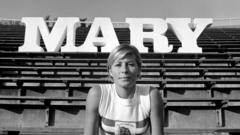
Mary Rand did not just win a gold medal at the 1964 Tokyo Olympics. She shattered a world record in the long jump, took silver in the pentathlon, and secured bronze in the relay, becoming the first British woman to win three medals at a single Games. Yet, for decades, her name has occupied a strange, quiet corner of athletic history. While her male contemporaries were knighted or transitioned into the comfortable architecture of sports broadcasting, Rand’s legacy suffered from a combination of rigid amateurism, a press corps that valued her aesthetics over her engine, and a sudden departure from the track that the establishment never quite forgave.
Understanding the "how" of her dominance requires looking past the black-and-white newsreels of her leaping into the sand. Rand succeeded because she was a technical polymath in an era that tried to force female athletes into narrow boxes. She possessed a rare explosive capacity—the kind of raw power usually reserved for pure sprinters—coupled with the spatial awareness of a high jumper.
The Myth of the Natural Athlete
The British sporting press of the 1960s loved a specific narrative. They wanted their champions to appear effortless, as if brilliance were a byproduct of good breeding and a bit of weekend jogging. Rand was frequently described as "willowy" or "the golden girl," terms that effectively stripped away the brutal reality of her training regimen.
She wasn't just a natural talent. She was an obsessive technician. In the lead-up to Tokyo, Rand spent hours refining her penultimate stride, the crucial split-second where a long jumper converts horizontal speed into vertical lift. This is where most athletes fail; they decelerate to gain height. Rand, however, mastered a method of maintaining nearly 95% of her sprint velocity through the takeoff.
At the 1960 Rome Olympics, she had been the favorite but collapsed under the pressure of the qualifying rounds, fouling her jumps and failing to make the final. That failure is what actually built the 1964 champion. She didn't just get faster; she rebuilt her psychological approach to the board. By the time she stood at the top of the runway in Tokyo, she had developed a sensory cues system—mapping out the exact feel of the track surface to adjust her stride length by centimeters.
The 6.76 Meter Revolution
When Rand hit the sand at 6.76 meters in Tokyo, she didn't just beat the field. She redefined the physical limits of the female body in the eyes of the public. Before that jump, the prevailing medical and social "wisdom" suggested that high-impact explosive movements were detrimental to women’s health. Rand’s performance was a violent rebuttal to that pseudoscience.
The jump was a masterpiece of physics. To achieve that distance, she needed an approach speed of roughly 9.5 meters per second.
$$d = \frac{v^2 \sin(2\theta)}{g}$$
While the simplified projectile motion formula above suggests a 45-degree angle is optimal, elite long jumpers like Rand actually take off at much lower angles—typically between 18 and 22 degrees—to preserve the horizontal velocity generated during the sprint. Rand’s ability to stay "tall" at the point of impact with the board meant her center of gravity was perfectly positioned to maximize her flight time without sacrificing forward momentum.
The Pentathlon Burden
Most modern fans don't realize that Rand’s long jump gold was only one part of a grueling schedule. The pentathlon of 1964 consisted of the 80m hurdles, shot put, high jump, long jump, and 200m sprint. It was an exhaustive test of versatility that the modern heptathlon has since expanded upon.
Rand took the silver in the pentathlon, losing gold only to the Soviet Union's Irina Press. The rivalry between Rand and Press was the personification of the Cold War sports divide. Press was the product of a state-sponsored, highly systematized sports machine. Rand was a product of the British "amateur" system, which essentially meant she had to find time to train while navigating the social expectations of a young mother and wife in a society that viewed her career as a temporary hobby.
The Amateurism Trap
The real reason Mary Rand’s name faded faster than those of her peers lies in the draconian rules of the International Olympic Committee (IOC) under Avery Brundage. In the 1960s, "professionalism" was a dirty word. Athletes were forbidden from earning money from their sport, their likeness, or even endorsements.
For a male athlete, a gold medal often led to a job in "public relations" for a large firm—a thinly veiled way to pay them to train. For Rand, the options were nonexistent. She was a superstar who couldn't pay her rent with her medals. When she moved to the United States and began to distance herself from the British athletic establishment, the UK sports media effectively turned the page.
There was a subtle, pervasive punishment for women who didn't stay within the geographical and social boundaries of the British sporting class. Because she didn't spend the next forty years sitting on committees or appearing on BBC panel shows, her 1964 exploits were treated as a fleeting moment of brilliance rather than the foundation of modern British track and field.
The Technical Gap in Modern Coaching
If you look at modern long jump technique, you see the fingerprints of Rand’s style. She was one of the first to utilize the "hitch-kick" in the air with such fluidity. This technique involves a running motion while airborne to counteract the forward rotation of the body, allowing the feet to stay extended forward for a fraction of a second longer before landing.
Today’s athletes have the advantage of high-speed cameras, force plates, and biomechanical sensors. Rand did it by feel. She had to internalize the feedback of the wind, the spring of the track, and the sound of her spikes hitting the wood.
The tragedy of the "Golden Girl" moniker is that it suggests she was lucky. It ignores the grit. It ignores the fact that she was training on cinder tracks that would shred a modern athlete's shins. It ignores the heavy leather shoes that lacked any of the energy-return technology found in modern carbon-plated spikes.
Why We Should Stop Calling Her a Trailblazer
Calling Mary Rand a "trailblazer" is a lazy way of avoiding the uncomfortable truth about how she was treated. A trailblazer clears a path for others, but the path Rand cleared was immediately grown over by systemic sexism and a lack of funding for women's sports that lasted for another thirty years.
She wasn't a pioneer who made things easy for the next generation; she was an outlier who succeeded despite a system that was designed to limit her. The British athletic board of the time was more concerned with the length of her shorts and her "ladylike" conduct than they were with providing the coaching infrastructure she deserved.
We often celebrate these figures to make ourselves feel better about the progress we've made. But if Rand were competing today, she wouldn't just be a gold medalist; she would be a global brand with a multi-million dollar Nike contract and a dedicated team of physiotherapists. In 1964, she was a woman who had to retire because she couldn't afford to keep winning.
The erasure of her technical brilliance in favor of her "charm" is a cautionary tale for modern sports journalism. When we focus on the personality of the athlete rather than the mechanics of their achievement, we contribute to the eventual disappearance of their legacy.
Compare the historical weight given to Rand versus her male contemporary, Lynn Davies, who also won long jump gold in Tokyo. Davies' victory is part of the British sporting canon, often spoken of with a reverent tone for its tactical brilliance in difficult weather. Rand’s win is often framed as a "dream come true" or a "shimmering achievement," a subtle demotion from technical master to lucky winner.
The High Cost of the Tokyo 1964 Legacy
There was no "next" for Mary Rand. The Tokyo games were her peak and her finale. She attempted to qualify for Mexico City in 1968 but was hindered by a recurring injury that the British sports medicine of the day couldn't diagnose or treat effectively.
She eventually left Britain, lived in the United States, and worked in a variety of jobs far removed from the Olympic spotlight. She didn't seek the adulation of the British press, and in return, they slowly stopped mentioning her.
This was the ultimate price of the amateur era: once your utility to the national brand was exhausted, the national brand had no further use for you. There was no pension, no transition program, and no support system for the greatest female athlete Britain had ever produced.
When you look at the footage of Rand jumping, don't look at the ribbon in her hair or the smile for the cameras. Look at the angle of her shin at takeoff. Look at the way she drives her knee upward to create the height she needs to hang in the air for what feels like an eternity. That's the real story of 1964. It’s not a fairy tale; it’s a masterclass in biomechanical efficiency performed by a woman who was technically decades ahead of her time.
The sand has long since been raked over her world record, but the physics of her flight remain a blueprint for every athlete who has followed in her footsteps, whether they know her name or not.
To honor her, we must stop telling her story through the lens of a "golden girl" and start telling it as a story of a technical revolutionary who was eventually discarded by a system that couldn't handle her success.
The next time you see a British woman on an Olympic podium, remember that the foundation was built not just on talent, but on the systematic defiance of an athlete who was told her place was in the kitchen, only to prove it was actually ten feet in the air.