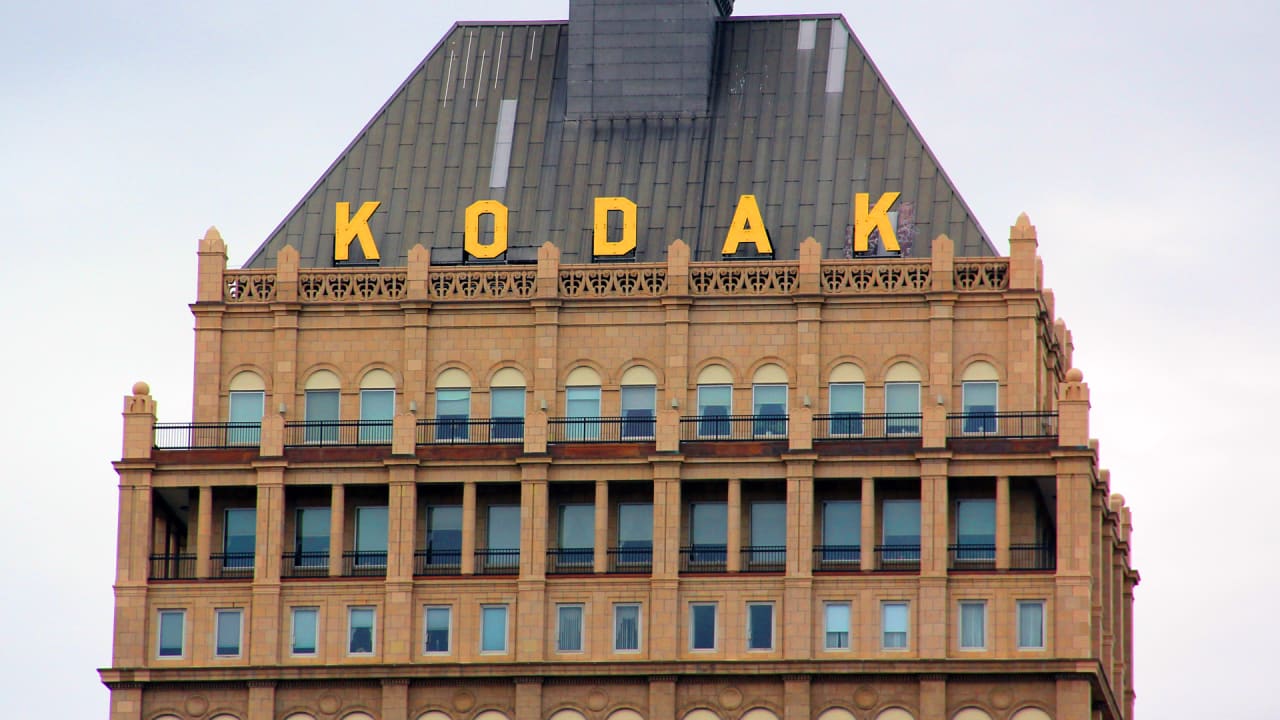
Eastman Kodak’s transition from a dominant consumer photography monopoly to a specialized industrial technology provider represents one of the most significant structural shifts in corporate history. The core problem was never a lack of innovation—Kodak invented the digital camera in 1975—but rather a catastrophic misalignment between its high-margin consumable chemistry model and the low-margin, high-velocity hardware requirements of the digital age. Success in the current era depends on the company's ability to repurpose its massive chemical manufacturing infrastructure and intellectual property into high-growth sectors: advanced materials, pharmaceuticals, and commercial print.
The Chemistry Utility Function: Infrastructure as an Asset
Kodak’s primary competitive advantage is no longer the "Kodak Moment" but its specialized knowledge in chemical deposition and coating. For decades, the company perfected the ability to layer complex chemical formulas onto thin films at high speeds with microscopic precision. This capability is the fundamental driver of its current pivot.
The logic follows a three-stage mechanical transfer:
- Deposition Expertise: Translating film coating technology to the manufacturing of battery electrodes and light-sensitive materials.
- Facility Utilization: Leveraging the 1,200-acre Kodak Park (now Eastman Business Park) to house high-density manufacturing that requires specific environmental controls and chemical waste management.
- Supply Chain Verticality: Controlling the raw chemical synthesis necessary for specialized industrial outputs, reducing dependency on external vendors.
By treating its legacy assets as a "Chemistry-as-a-Service" platform, Kodak shifts from a product-centric company to a substrate-centric one. This is not a rebranding; it is a fundamental retooling of the cost-per-unit logic inherent in chemical manufacturing.
The Pharmaceutical Inflection and the Defense Production Act
The attempt to enter the pharmaceutical market via the Defense Production Act (DPA) loan process signaled a strategic intent to address the structural fragility of the U.S. drug supply chain. While the $760 million loan became mired in regulatory and political friction, the underlying business logic remains sound: Kodak possesses the exact equipment required to manufacture Active Pharmaceutical Ingredients (APIs).
The bottleneck in API production is the scarcity of facilities capable of continuous-flow chemistry and large-scale synthesis. Kodak’s existing infrastructure can be adapted to produce the generic building blocks of medications. The economic rationale relies on "Regulatory Arbitrage"—capitalizing on the desire for domestic production to offset the lower labor costs of overseas competitors. The risk, however, is the high barrier to entry regarding FDA Good Manufacturing Practice (GMP) certifications. Kodak must bridge the gap between industrial-grade chemical production and human-grade pharmaceutical compliance.
Digital Print and the High-Volume Commercial Sector
Kodak’s survival depends heavily on its Advanced Materials and Chemicals (AM&C) and Digital Print segments. The commercial print market differs from the consumer market in its sensitivity to "Total Cost of Ownership" (TCO) and throughput.
The company's PROSPER and ULTRASTREAM inkjet technologies utilize continuous inkjet (CIJ) systems. Unlike "drop-on-demand" systems used in home printers, CIJ maintains a constant flow of ink, which allows for significantly higher speeds and lower maintenance.
The Profitability Variables in Commercial Print:
- Ink Coverage Efficiency: The ratio of pigment density to solvent volume, which dictates the cost per page.
- Substrate Versatility: The ability to print on diverse materials (plastic, foil, recycled paper) without losing adhesion.
- Downtime Minimization: The engineering of self-cleaning print heads to prevent the "clogging" common in high-viscosity ink applications.
This segment functions as a "razor-and-blade" model, but at an industrial scale. The hardware is the entry point, but the recurring revenue comes from proprietary inks and service contracts. The success of this division is the litmus test for whether Kodak can maintain a moat against competitors like HP and Ricoh.
Structural Impediments and the Legacy Debt Trap
Any analysis of Kodak must account for the "Anchor Effect" of its legacy costs. Despite the 2012 bankruptcy and subsequent reorganization, the company faces two primary structural headwinds:
- Pension and Environmental Liabilities: Managing the cleanup of century-old industrial sites and fulfilling obligations to a massive former workforce creates a constant drain on free cash flow.
- Capital Expenditure (CapEx) Intensity: Moving into new markets like EV battery components requires significant upfront investment in specialized machinery. If the adoption rate of Kodak’s specific coating technology lags, the company risks a liquidity crunch.
These factors create a narrow margin for error. The strategy is essentially a race between the declining revenue of traditional film and the scaling of new industrial applications.
The EV Battery Component Opportunity
The most promising high-growth vertical for Kodak is the production of battery separators and coated electrodes for Electric Vehicles. The manufacturing process for an EV battery electrode is remarkably similar to that of color film: a substrate (copper or aluminum foil) is coated with a precise layer of active material (lithium-ion slurry).
Kodak is currently repurposing its "wide-roll" coating machines, which cost tens of millions of dollars to build from scratch, to produce these components. This gives the company a massive "Time-to-Market" advantage. While a competitor would need years to permit and build a coating facility, Kodak can recalibrate existing lines in months.
The technical challenge lies in the "Purity Requirement." Batteries are intolerant of the contaminants that might have been acceptable in photographic film. Achieving "Six Sigma" quality levels in a repurposed environment is the primary engineering hurdle.
Strategic Forecast: The Narrow Path to Industrial Relevance
Kodak’s path forward is not a return to consumer relevance, but a deep integration into the global industrial supply chain. The company's valuation will likely decouple from the "photography" sector entirely and move toward a specialty chemicals multiple.
The decisive move for leadership is the aggressive divestment of non-core brand licensing and a 100% focus on the "Coating-as-a-Service" model. Success requires securing long-term supply agreements with Tier-1 battery manufacturers and pharmaceutical distributors to stabilize cash flow. If Kodak fails to secure these contracts within the next 24 to 36 months, its infrastructure will become a liability rather than an asset, leading to a secondary liquidation event. The current objective is to prove that "Industrial Muscle Memory"—the ability to manufacture complex chemistry at scale—is a transferable skill in a post-analog economy.