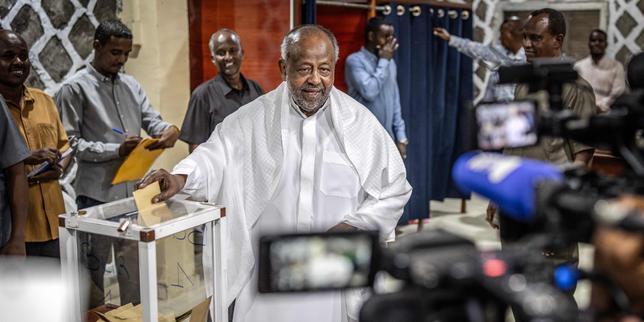
Western media loves a predictable villain. When Ismaïl Omar Guelleh (IOG) secures his fifth or sixth term in Djibouti, the editorial desks in Paris and Washington dust off the same tired template: "Sham elections," "crushed opposition," and "democratic backsliding." It is lazy. It is performative. Most importantly, it is factually incomplete because it ignores the cold, transactional reality of the Horn of Africa.
The "lazy consensus" argues that Djibouti’s lack of democratic churn is a failure of its political system. The reality? Djibouti’s "stability" is a high-priced commodity that the United States, China, France, and Japan are more than happy to purchase at the cost of local civil liberties. If you want to understand why IOG stays in power, stop looking at the ballot boxes and start looking at the lease agreements for military bases.
The Geopolitical Landlord
Djibouti is not a country in the traditional Westphalian sense; it is a city-state masquerading as a nation to function as the world’s most strategic parking lot. It sits at the Bab-el-Mandeb strait, a chokepoint through which 10% of global oil exports and 20% of all commercial goods pass.
While the "pro-democracy" crowd wrings its hands over IOG's longevity, the Pentagon is focused on Camp Lemonnier. Beijing is focused on its first overseas naval base in Doraleh. They aren't looking for a vibrant, unpredictable democracy that might suddenly decide to hike rent or, worse, pivot its foreign policy based on a populist whim. They want a landlord who picks up the phone and keeps the lights on. IOG has mastered the art of being the only reliable landlord in a neighborhood of burning houses.
The Myth of the Viable Opposition
Critics point to the 2021 election—where IOG reportedly took over 97% of the vote—as proof of a broken system. Of course it is a rigged figure. But the contrarian truth is that even a "fair" election in the current climate wouldn't produce a Jeffersonian democracy. It would produce chaos.
In Ethiopia, reform led to a civil war in Tigray. In Somalia, federalist experiments struggle against Al-Shabaab. In Sudan, the transition to civilian rule ended in a catastrophic military shootout. The regional data suggests that in the Horn of Africa, sudden democratic openings are often precursors to state collapse. I’ve seen diplomats argue behind closed doors that they would rather deal with a predictable autocrat than a chaotic "democrat" who cannot control his own borders. Djibouti is the only place in the region where a French soldier can go out for coffee without a bulletproof vest. That safety has a price, and that price is the suppression of domestic political competition.
The China Debt Trap is a Western Fairy Tale
One of the most frequent accusations leveled against Guelleh is that he has sold the country to China. The narrative goes like this: IOG took on billions in loans for infrastructure (the Addis Ababa-Djibouti railway, the Doraleh Multipurpose Port) that the country can never repay, giving Beijing a "debt trap" lever.
This is a fundamental misunderstanding of how IOG plays the great powers against each other. He isn't a victim of Chinese predatory lending; he is an arbitrageur.
- Multilateral Hedging: By hosting the Americans and the Chinese simultaneously, Djibouti ensures that neither can ever fully pull the rug out. If the US pressures him too hard on human rights, he signs a new port deal with China Merchants Group. If China gets too demanding, he reminds them that the US military is literally a few miles down the road.
- The Rent is Due: Unlike other African nations that export oil or minerals, Djibouti’s primary export is sovereignty. The annual rent from foreign bases brings in over $125 million. This isn't "debt"; it's a recurring revenue stream that Guelleh uses to maintain his security apparatus and keep the urban elite satisfied.
The West cries "debt trap" because they hate that they no longer have a monopoly on influence in the region. They are mad that Guelleh found a better lender who doesn't ask annoying questions about the 97% vote margin.
Why the "Poverty vs. Growth" Argument Fails
Standard reporting highlights that despite the massive port investments, nearly 20% of Djiboutians live in extreme poverty. The "competitor" take is that Guelleh has failed his people.
This assumes that the goal of the Djiboutian state is equitable wealth distribution. It isn't. The goal is the maintenance of a maritime hub. In a desert nation with zero natural resources and almost no arable land, the "trickle-down" effect of a high-tech port is naturally limited to the service sectors and the state bureaucracy.
Imagine a scenario where a new leader takes over and tries to pivot from a port-centric economy to an industrial one. Where is the water? Where is the raw material? Djibouti is a rock. Its only value is its coordinates on a map. Guelleh understands this better than any NGO. He isn't trying to build a diversified economy; he is building a fortress that provides services to the world's navies. Expecting him to turn Djibouti into Singapore without the human capital or the geographic advantages of Southeast Asia is a fantasy.
The Security Paradox
The "People Also Ask" sections of the internet often focus on whether Djibouti is "safe." The answer is a brutal "yes," but only because of the very things the West claims to hate.
- Total Surveillance: The state knows who you are and who you talk to. This prevents Al-Shabaab from establishing cells.
- No Dissent: This prevents the ethnic fracturing that has destroyed Yemen just across the water.
- Foreign Presence: The sheer density of foreign militaries acts as a deterrent against external invasion.
If you remove Guelleh without a pre-vetted, equally strong successor, you don't get "freedom." You get a power vacuum at the most sensitive maritime junction on earth. The global economy is literally betting on IOG's ability to keep the peace, even if it's the peace of the graveyard.
The Professional’s Take on the "Sixth Term"
The outrage over a sixth term is a Western luxury. For the shipping companies moving containers through the SGR railway, the number of terms doesn't matter. What matters is the "TEU" (Twenty-foot Equivalent Unit) throughput at the port. Under Guelleh, that number has skyrocketed.
$Total Revenue = Base Rent + Port Fees + Strategic Leverage$
As long as that equation remains positive for the ruling family and the global powers, IOG isn't going anywhere. He has turned a tiny, resource-poor desert into an indispensable piece of global infrastructure.
Stop asking when Djibouti will have a "fair" election. That’s the wrong question. The right question is: Can the world afford a Djibouti that isn't under the iron grip of a single man? The answer, evidenced by the silence of the world’s superpowers every time he is "re-elected," is a resounding no.
The West doesn't want a revolution in Djibouti. They want a signature on the lease renewal. Guelleh provides the signature, and in exchange, he gets to stay in the palace. Everything else is just theater for the press.
Buy the stability. Ignore the rhetoric. The landlord is staying put.



