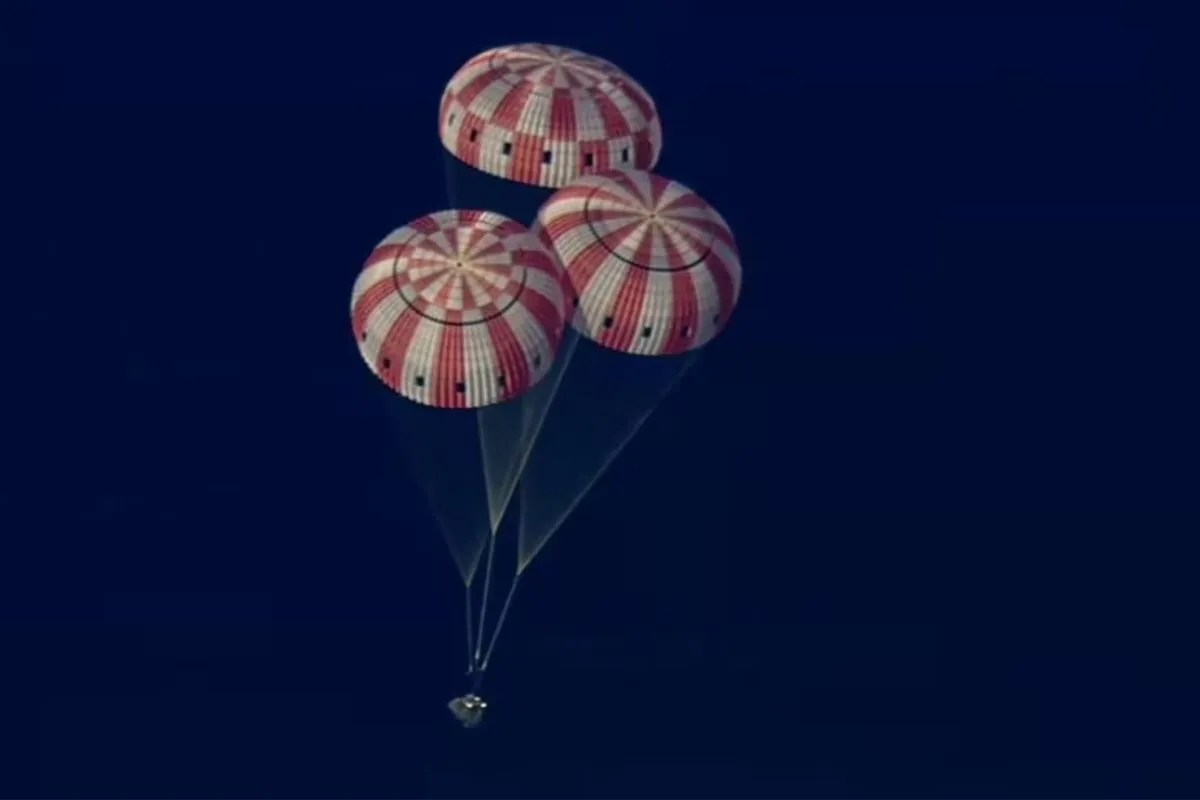
Fifty years of lunar silence ended not with a giant leap, but with a calculated, high-stakes rehearsal. NASA successfully brought a human-rated spacecraft back from the moon’s doorstep, proving that the Orion capsule can survive the violent friction of reentry at speeds exceeding 25,000 miles per hour. This wasn't just a technical milestone. It was a desperate validation of a multi-billion dollar architecture that has been criticized for being too slow, too expensive, and potentially obsolete before it even clears the launchpad. The success of the Artemis I mission provides the foundation for Artemis II, which will carry a crew around the lunar far side, and Artemis III, the mission intended to actually put boots back on the regolith.
But the headlines often gloss over the sheer fragility of this comeback. We aren't just repeating Apollo. We are attempting to build a permanent presence in a graveyard of failed ambitions, using a supply chain that is significantly more fragmented than it was in the 1960s.
The Architecture of Necessity
To understand why it took five decades to get back to this point, you have to look at the bones of the Space Launch System (SLS). Critics often call it the "Senate Launch System" because it utilizes components from the Space Shuttle era—solid rocket boosters and RS-25 engines—to keep legacy contracts alive across specific congressional districts. It is a beast of a machine, capable of pushing the Orion capsule into a Trans-Lunar Injection orbit, but it is also an expendable one. Every time an SLS flies, nearly $2 billion worth of hardware sinks to the bottom of the ocean.
This is the central tension of modern lunar exploration. NASA is operating on a budget that is a fraction of its Apollo-era peak when adjusted for inflation. During the 1960s, the agency consumed roughly 4% of the federal budget. Today, it operates on less than 0.5%. To survive, the agency had to pivot from being the sole architect of space travel to becoming a primary customer for commercial partners.
The Orion capsule itself is a marvel of redundant systems. Unlike the Apollo Command Module, Orion is designed for deep-space endurance. It features advanced radiation shielding to protect the crew from solar flares and cosmic rays, which are far more intense once you leave the protective cradle of Earth's magnetic field. During its recent uncrewed test, the heat shield endured temperatures of 5,000 degrees Fahrenheit. That is roughly half the temperature of the surface of the sun. If that shield fails by even a fraction of a percentage point, the mission becomes a funeral pyre.
The Lunar Gateway and the Hidden Risks
The plan isn't to just land and leave. NASA’s long-term strategy involves the Lunar Gateway, a small space station that will orbit the moon. Think of it as a staging area or a high-altitude gas station. The idea is that astronauts will fly from Earth to the Gateway, then transfer to a different vehicle—the Human Landing System (HLS)—to descend to the surface.
This adds layers of complexity that would have made Apollo engineers sweat. Every docking maneuver is a potential point of failure. Every transfer of fuel or life support is a gamble. The "why" behind this complexity is logistical: if you want to stay on the moon for months rather than days, you cannot carry everything you need in one shot. You have to build a local infrastructure.
However, this reliance on a modular approach introduces a terrifying dependency on private contractors. SpaceX is currently developing the Starship HLS, which is the vehicle that will actually touch down on the moon. But Starship is a radical departure from traditional rocket design. It requires multiple refueling launches in Earth orbit just to get enough "gas" to reach the moon. If Elon Musk’s team cannot master rapid-fire orbital refueling, the entire Artemis timeline collapses.
The Geopolitical Pressure Cooker
We aren't racing the Soviets anymore. We are racing the clock and a rising Chinese space program that doesn't have to deal with the whims of a four-year election cycle. China has already landed rovers on the far side of the moon and returned samples to Earth with clockwork precision. They have stated their intent to put taikonauts on the lunar surface by 2030.
For the United States, the moon is no longer just about prestige. It is about the "high ground." The lunar south pole is believed to contain vast deposits of water ice hidden in permanently shadowed craters. Water is the oil of the solar system. It can be broken down into oxygen for breathing and hydrogen for rocket fuel. Whoever controls the ice controls the ability to move further into the solar system, specifically toward Mars.
This is why the recent mission success was so vital. Had Orion failed to return safely, the political appetite for funding Artemis would have evaporated. The program has already faced years of delays and billions in cost overruns. It survived because it finally delivered a win.
The Human Factor and Biological Limits
We often talk about rockets as if the metal is the only thing that matters. The reality is that the human body is the weakest link in deep space exploration. Beyond the Van Allen radiation belts, the risks of cancer, cardiovascular issues, and neurological decay increase significantly.
During the Artemis I flight, "Mannequin Skywalker" and two other phantom torsos were rigged with sensors to measure exactly how much radiation a human would soak up. The data revealed that while the shielding is effective, a multi-month stay on the Gateway or the surface will require even more robust protection. We are talking about burying habitats under meters of lunar soil (regolith) just to keep the occupants alive.
Microgravity also wreaks havoc on bone density and muscle mass. On the International Space Station (ISS), astronauts spend hours a day on treadmills and resistance machines. On the moon, with one-sixth of Earth's gravity, the decay will be slower but still persistent. Reclaiming the moon means solving the problem of long-term biological survival in an environment that is actively trying to kill us.
The Cost of the Leap
Let’s talk about the money, because that is where the real investigation begins. The SLS program has cost roughly $23 billion to develop. Each launch costs a staggering amount. When you compare this to the plummeting costs of commercial launch providers, the math looks grim.
- SLS Launch Cost: Approximately $2.2 billion per flight.
- SpaceX Starship Goal: Potentially under $100 million per flight through total reusability.
Why keep the expensive one? Because the government values "assured access." They cannot risk a single private company having a monopoly on deep space. They want a "state-owned" option, even if it is a financial albatross. This dual-track strategy—using the reliable but expensive SLS and the innovative but unproven Starship—is the biggest gamble in the history of the agency.
The Lunar South Pole Stakes
The choice of the South Pole as a landing site isn't accidental. It is a treacherous landscape of jagged shadows and extreme temperature swings.
- Light: Some peaks enjoy near-constant sunlight, perfect for solar power.
- Ice: The nearby craters are cold traps where water has remained frozen for billions of years.
- Communication: It is harder to maintain a direct line of sight with Earth from the poles, necessitating a constellation of relay satellites.
If Artemis III succeeds, we will see the first woman and the first person of color on the moon. That is a powerful cultural milestone, but the scientific community is more interested in the ice. If we can't extract it and turn it into fuel, the dream of a permanent lunar base is dead on arrival. We cannot afford to "ship" water from Earth at $10,000 per gallon.
Engineering the Reentry
When Orion hit the atmosphere on its return, it performed a "skip reentry." Imagine skipping a stone across a pond. The capsule dipped into the atmosphere, bounced back up into space to shed some heat and velocity, and then made its final descent. This maneuver allowed for a more precise splashdown and reduced the G-loads on any future crew.
It worked perfectly. But a test with a mannequin is not a test with a commander. In a crewed mission, every vibration, every flicker of the life support system, and every communication delay becomes a potential crisis. The transition from Artemis I to Artemis II is the jump from a laboratory experiment to a live-fire exercise.
The moon is not a destination; it is a laboratory for Mars. Everything we do there—the habitat construction, the ice mining, the long-term radiation monitoring—is a dress rehearsal for a three-year round trip to the Red Planet. If we can't master the three-day trip to the moon, Mars remains a fantasy.
The Fragile Path Forward
The success of NASA's recent mission didn't just prove we could get back to the moon; it proved we haven't forgotten how to do hard things under immense pressure. However, the path forward is narrow and littered with potential "kill switches." Budget cuts, a single catastrophic failure, or a shift in political winds could still ground the program for another generation.
We are currently in a period of "sunk cost" momentum. So much has been spent and so much has been promised that the only way out is through. The next few years will determine if the 2020s are remembered as the decade we became a multi-planetary species or the decade we finally admitted that the moon was too far and too expensive to keep.
The hardware is ready. The math is settled. The only remaining variable is the collective will to keep paying the bill when the initial excitement of the "first landing" fades into the grind of routine maintenance.
Check the telemetry. The window is open, but it won't stay that way forever. Move now, or stay grounded.